Tesamorelin reduces fat stored deep inside the abdomen in adults with HIV-related changes in body fat. In large controlled trials, the reduction was visible on scans after six months. The trials do not show that it is a general weight-loss medicine, a way to erase the fat someone can pinch at the waist, or a proven way to prevent heart disease. Those distinctions matter when a search for tesamorelin belly fat results leads to dramatic claims.
The US prescription product Egrifta WR contains tesamorelin, a manufactured version of a signal that prompts the pituitary gland to release growth hormone. Its official product label limits its use to reducing excess abdominal fat in adults with HIV and lipodystrophy, a change in where the body stores fat. It explicitly says the product is not for weight-loss management. This article explains the research behind that narrow use and what remains uncertain.
What kind of belly fat did researchers measure?
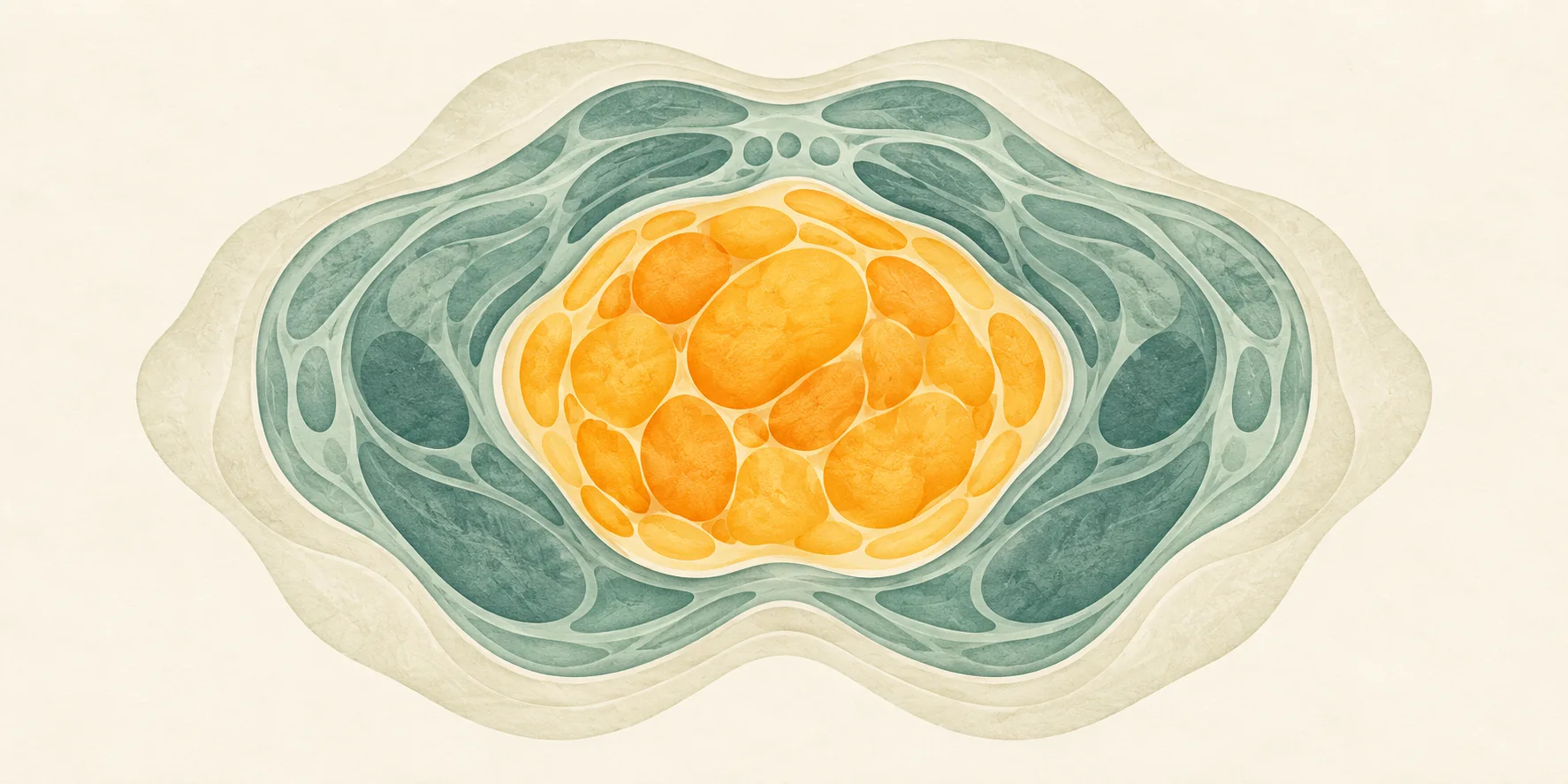
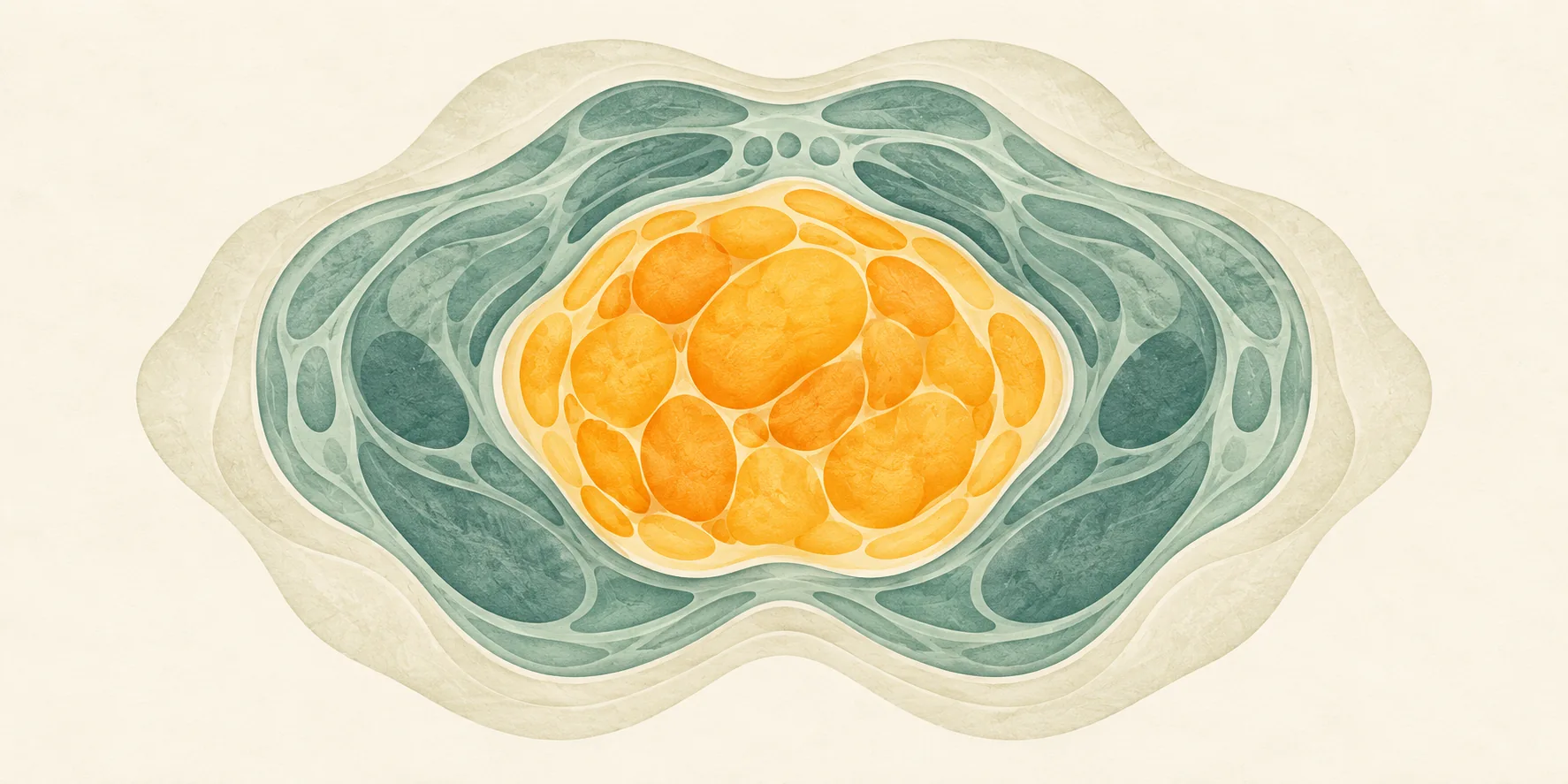
Visceral fat sits deep in the abdomen, around internal organs. Subcutaneous fat lies beneath the skin and can often be pinched. A waist measurement includes both compartments, along with muscle, posture, and normal changes in the digestive tract. A photograph cannot reliably tell how much visceral fat a person has. The main tesamorelin trials used CT scans to measure a cross-sectional area of deep abdominal fat. Some later studies used magnetic resonance methods to examine fat in the liver.
An area on one scan slice is not the same as pounds lost from the whole body. This is why a clear result on a scan may not match a person's expectation of a flat lower belly or disappearing love handles. It also explains why the best trial result should be described as a change in a particular fat depot, rather than a promise about appearance or weight.
The large trials: less deep fat after six months
The pooled 2010 phase 3 analysis (https://pubmed.ncbi.nlm.nih.gov/20554713/) brought together two multicenter studies of 806 adults receiving HIV treatment who had excess abdominal fat. Researchers assigned 543 participants to tesamorelin and 263 to an identical-looking inactive injection for 26 weeks. Random assignment and a placebo comparison helped separate the medicine's effect from changes caused by time, expectations, or other care. CT scans supplied the main measurement.
At week 26, deep abdominal fat area had fallen by an average of 24 square centimeters in the tesamorelin group and risen by 2 square centimeters in the placebo group. The authors described the difference as a 15.4% treatment effect. Fat immediately under the abdominal skin did not show a significant difference. Triglycerides, a type of blood fat, improved on average, and participants reported less distress about belly appearance. The growth-related blood marker IGF-1 rose substantially.
The result is meaningful for the population studied: people with HIV-associated fat accumulation. It does not say that every participant responded, or that a 15.4% difference means losing 15.4% of total body weight. The study measured a fat area, blood markers, and reported appearance distress. It did not test whether participants lived longer or had fewer heart attacks. The original trials were industry sponsored, so independent replication and careful reading of safety results are especially useful.
The separate 2010 randomized trial with a safety extension (https://pubmed.ncbi.nlm.nih.gov/20101189/) followed 404 adults. During its first six months, visceral fat fell about 10.9% with tesamorelin and 0.6% with placebo. Participants who kept taking tesamorelin maintained a larger reduction through one year. Those switched from tesamorelin to placebo rapidly lost much of the earlier reduction. This extension is unusually helpful for a practical question: a short course did not permanently reset deep fat storage in that study.
An earlier 2007 randomized trial (https://pubmed.ncbi.nlm.nih.gov/18057338/) also found less visceral fat after 26 weeks in adults with HIV-related abdominal fat. Its tesamorelin group had a 15.2% decrease, while the placebo group had a 5.0% increase. This study reinforces the same narrow conclusion. It is part of the evidence later assembled in the pooled analysis, so it should not be counted as a completely separate group of 806 additional patients.
What about people without HIV?
The 2012 randomized trial in abdominal obesity (https://pubmed.ncbi.nlm.nih.gov/23015655/) enrolled 60 selected adults who did not have HIV-related lipodystrophy. They had excess abdominal fat and relatively low growth-hormone secretion. After one year, the difference in visceral fat area favored tesamorelin by about 35 square centimeters compared with placebo. The researchers did not find a clear difference in abdominal fat under the skin. They also observed changes in triglycerides and a measure of artery wall thickness.
That trial matters because it tests whether the biological effect might exist outside HIV care. Its small, carefully selected sample cannot establish benefit for every person with ordinary weight gain. Artery wall thickness is a risk marker measured with ultrasound; it is not a count of strokes or heart attacks. The study did not establish long-term safety in a general population or support an approved general weight-loss use. Someone with a soft lower-belly fold may be asking about a different fat compartment from the one that changed in the trial.
Liver fat findings are promising, with limits
Fat can also build up inside the liver. The 2014 six-month trial (https://pubmed.ncbi.nlm.nih.gov/25038357/) randomly assigned 50 adults with HIV and abdominal fat accumulation to tesamorelin or placebo. The difference in deep abdominal fat area favored tesamorelin by 42 square centimeters. Liver fat also decreased more in the tesamorelin group, with a difference of 2.9 percentage points in the measured liver-fat-to-water ratio. These were scans and magnetic resonance measurements, not evidence of fewer cases of liver failure. Glucose rose briefly early in treatment, while the main glucose comparisons at six months were unclear.
A later one-year study of HIV-associated fatty liver (https://pubmed.ncbi.nlm.nih.gov/31611038/) enrolled 61 people and assigned 30 to tesamorelin and 30 to placebo. One enrolled person did not start the assigned treatment. Liver fat fell more with tesamorelin, with an average difference of 4.1 percentage points at 12 months. About 35% of treated participants versus 4% of placebo participants had liver fat below the study's 5% threshold. Blood sugar measures did not differ clearly between groups at one year, although injection-site complaints were more frequent with tesamorelin.
Those findings support further study in this specific group. They do not establish treatment for every cause of fatty liver or demonstrate that a person will avoid cirrhosis. The trial was relatively small and lasted one year. A 2024 analysis of participants taking modern integrase-inhibitor HIV medicines (https://pubmed.ncbi.nlm.nih.gov/38905488/) found similar directions of change in deep and liver fat, but it was a subgroup of the earlier liver trial. It cannot be counted as a fresh independent trial.
How much of the result would someone notice?
The trials give a firmer answer about scans than about a mirror. A person with HIV-related lipodystrophy may notice a change in their abdominal profile or feel less distress about it, as some study participants reported. Yet the same trials found little or no change in abdominal fat directly beneath the skin. The degree of visible change is likely to vary with a person's starting body shape and the amount of fat in each compartment. There is no reliable conversion from the average scan result to a promised number of inches off a particular reader's waist.
Treatment duration also matters. The strongest controlled comparisons lasted 26 weeks; some extensions and smaller trials lasted one year. They do not show that a few weeks of treatment reliably changes appearance. The extension in which the effect faded after stopping suggests that maintenance and cost can matter in real life. It does not prove that everyone will regain fat at the same speed.
Tesamorelin is sometimes discussed alongside other peptides. None of the trials above establishes that combining it with ipamorelin, CJC-1295, or another agent improves results or safety. A combination changes the experiment. For background on why a finding about one peptide cannot simply be transferred to another, see our CJC-1295 human and animal research guide.
Safety is part of the answer
The current US label warns that tesamorelin can raise IGF-1 and blood glucose, and it calls for monitoring both. IGF-1 is a growth-related hormone signal. Higher IGF-1 is a biological effect, not proof of better health. The label reports that 5% of treated trial participants versus 1% of placebo participants crossed its high HbA1c threshold by week 26. HbA1c is a blood test that reflects average blood sugar over roughly three months. An average glucose result that looks reassuring can coexist with a higher-risk subgroup.
Fluid retention may cause swelling, joint discomfort, or carpal-tunnel symptoms. Injection-site reactions and allergic reactions also occur. The label says people with active cancer, certain pituitary problems, pregnancy, or known serious allergy to the product should not use it. Long-term cardiovascular safety has not been established. A clinician can weigh those issues against the measured benefit for a person who actually fits the studied condition.
Product identity matters as well. The label says Egrifta WR and Egrifta SV have different formulations and instructions and are not interchangeable. A vial marketed online as tesamorelin is not automatically the approved medicine studied in these trials. Its name alone does not confirm purity, sterility, or how much active peptide it contains. The evidence belongs to defined products used under defined conditions.
The useful question for a person with HIV-related abdominal fat is whether deep fat is the concern, what benefit is realistic, and what monitoring fits their health history. For general cosmetic weight loss, the evidence is much less direct and the approved indication does not cover it. Tesamorelin has a genuine, measurable effect in human trials. The honest limit is that a smaller fat area on a scan is not a guaranteed visible transformation or a proven long-term health outcome.