GHK-Cu has been studied in topical skin products, but the results are mixed and do not establish that injecting it improves skin, hair, or healing. Some people using a copper peptide serum describe calmer, smoother skin. Others describe irritation or no visible change. Those accounts become even harder to interpret when GHK-Cu is used in a blend with KPV, BPC-157, and TB-500.
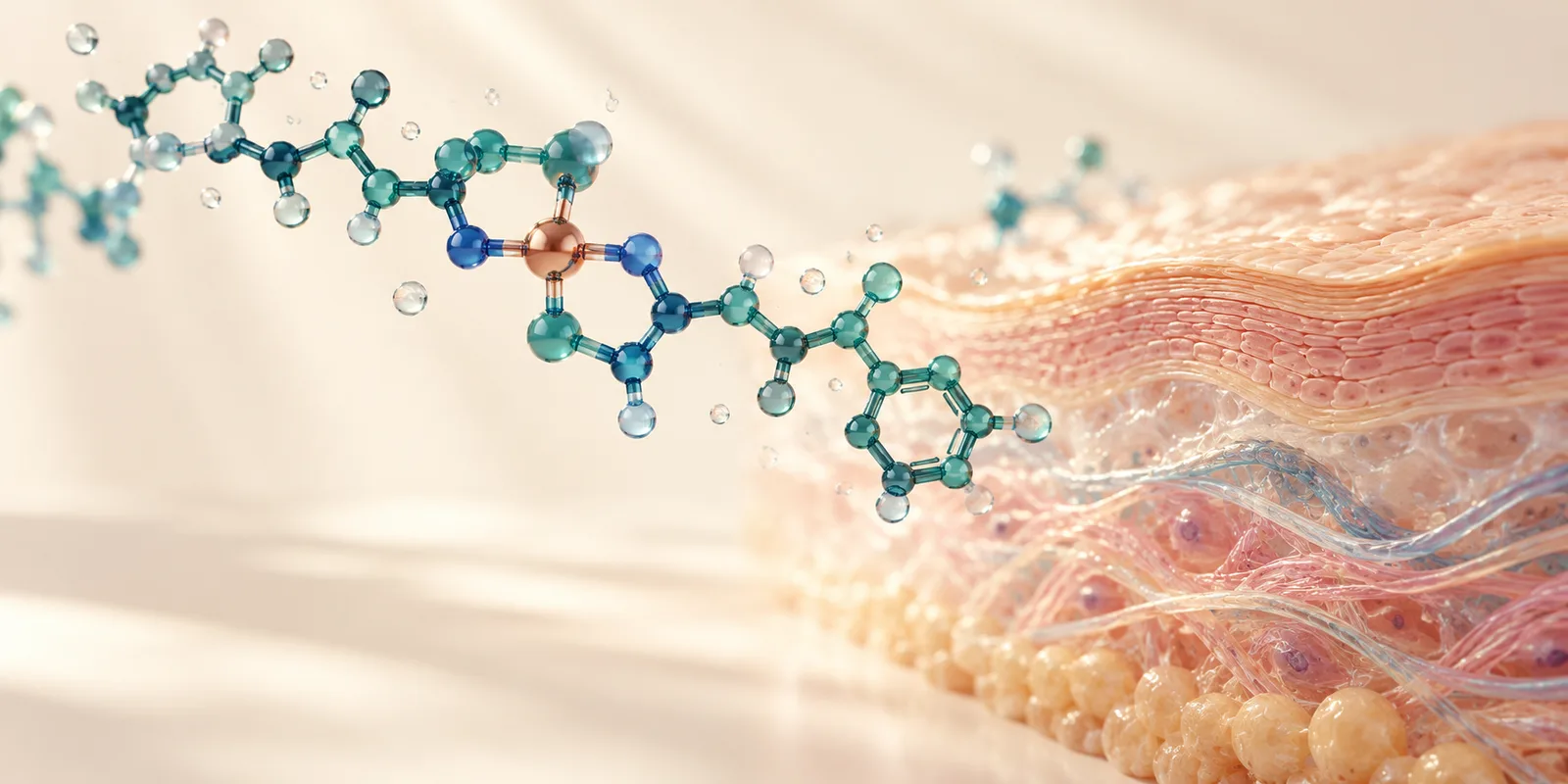
GHK is a chain of three amino acids, glycine, histidine, and lysine. It binds copper, which is why the resulting complex is called GHK-Cu or copper tripeptide-1 on cosmetic labels. A blue color can be visually memorable, but it does not tell a buyer how much active peptide is present, how far it reaches into skin, or whether a particular product has been tested. Product formulation and route matter as much as the attractive molecular story.
People often hear one broad claim that copper peptides rebuild skin. The original research asks narrower questions. Did a topical product change wound closure? Did it reduce redness after a cosmetic procedure? Did an instrument detect a wrinkle change? Did a user simply prefer how their skin felt? Keeping those outcomes separate makes the science more useful.
What users describe after topical use
In a Reddit discussion about copper peptide serums, one user said a product containing copper tripeptide felt gentle alongside an existing skin-care routine. Another reported serious irritation with a different copper-peptide product and reduced how often they used it (the original serum discussion). The contrast is a reminder that a serum contains a whole formula, not one isolated ingredient. Fragrance, preservatives, other active ingredients, and the condition of the skin barrier can all affect how a product feels.
A separate user described new visible lines after starting a GHK-Cu serum and became concerned that the product made the skin look older (the detailed account). The writer also noticed the lines changed over the day and with sleeping position. That leaves several possible explanations. The post is worth including as an experience of worry and a perceived change, but it cannot establish that copper peptide damaged collagen.
Another recent user said four weeks of topical GHK-Cu coincided with less redness and skin that felt plumper (the four-week account). The writer did not compare the serum with a matching product lacking GHK-Cu. Lighting, hydration, other products, and ordinary variation can change how skin looks. A good personal report tells us what someone noticed. It does not measure an average treatment effect.
The varied accounts should temper both enthusiasm and alarm. A bad reaction is a reason to take a person's symptoms seriously. A favorable story can help identify questions worth testing. Neither supplies a controlled answer about long-term skin structure or whether one copper peptide formula is better than another.
The human study that found little objective benefit
The 2006 Miller study (https://pubmed.ncbi.nlm.nih.gov/16847171/) tested a GHK-Cu-containing skin regimen after carbon dioxide laser resurfacing around the mouth. Participants were randomly assigned to post-procedure care with or without the copper peptide complex. Thirteen completed the study. The researchers used computer analysis and blinded evaluators to assess redness as healing progressed, then looked at wrinkles and overall skin appearance at 12 weeks. Patients also completed a questionnaire.
The objective findings were disappointing for the peptide. Redness did not resolve significantly faster. Both groups improved in wrinkles and overall appearance after the laser procedure, but the groups did not differ on those measured outcomes. People in the GHK-Cu group reported greater satisfaction with overall skin quality on the questionnaire. Their perception matters, yet it cannot override the null objective comparisons or isolate the peptide from the entire regimen.
This was a small study in a very specific setting. Laser-treated skin is not the same as intact skin receiving a daily cosmetic serum. Thirteen completers are too few to rule out modest effects. At the same time, the trial directly challenges the claim that adding GHK-Cu reliably speeds visible recovery after a procedure. A reader should not replace its measured results with a dramatic before-and-after picture from another context.
An older wound trial needs careful reading
The 1994 multicenter study by Mulder and colleagues (https://pubmed.ncbi.nlm.nih.gov/17147644/) tested a topical GHK-Cu complex in people with diabetic neuropathic foot ulcers. It was randomized, placebo-controlled, and assessed by evaluators who did not know which treatment a patient received. Everyone also had standardized care, including wound cleaning, pressure-relieving footwear, and education. Those measures are essential to the context. The gel was studied as an addition to structured wound care, not a replacement for it.
The authors reported greater median closure of plantar ulcers with the copper-peptide gel than with its vehicle and fewer infections in a subgroup treated immediately after wound preparation. The PubMed abstract does not state the total number of participants or provide the full pattern of every subgroup and adverse event. A claim about how often the gel would help today's patients needs the full paper and a careful look at the statistical plan. Still, this was human research on a topical GHK-Cu complex and a meaningful clinical outcome, so it deserves more weight than a cell experiment.
A diabetic foot ulcer is also very different from a facial fine line. The damaged skin barrier, disease state, wound care, formulation, and outcome all differ. The result cannot establish that a cosmetic serum reverses aging, grows hair, or that an injection works better than topical use. Someone with a new or worsening foot wound should seek clinical assessment promptly because infection and poor circulation can change its course quickly.
What newer skin research adds
A 2026 study by Wang and colleagues (https://pubmed.ncbi.nlm.nih.gov/42573538/) combined GHK-Cu with a bacterial fermentation extract in a face cream. The researchers first tested inflammatory signals in mouse cells and ultraviolet-exposed human skin samples kept alive outside the body. They then enrolled 32 adults with sensitive skin, mostly women, who used the combined cream for 56 days. Instruments and assessors tracked wrinkles, skin barrier measures, and appearance over time.
The authors reported improvements from baseline. The key limitation is that everyone in the human portion received the same cream. There was no vehicle-only group and no GHK-Cu-only group. The cell experiment compared components, but the human experiment cannot tell us whether the copper peptide, the ferment extract, the cream base, normal seasonal change, or a combination produced the result. The authors worked at the cosmetic company involved in developing the extract. That does not make their measurements worthless, but it makes independent controlled replication valuable.
Another 1988 laboratory study (https://pubmed.ncbi.nlm.nih.gov/3169264/) found that GHK-Cu could stimulate collagen synthesis in cultured fibroblasts. Fibroblasts are cells involved in skin's supporting matrix. A response in a dish supports a plausible biological question. It does not show that applying a serum leads to the same concentration in living skin, or that an injection improves facial appearance safely.
The literature is easy to inflate by borrowing results from other molecules. A hair-follicle experiment often cited online used AHK-Cu, a different copper peptide, rather than GHK-Cu. Copper oxide wound dressings are also different from a GHK-Cu gel. Similar names or shared copper do not make their clinical effects interchangeable.
Why some people inject GHK-Cu anyway
People who inject the peptide often want a body-wide skin effect or believe it will reach deeper tissues than a serum. A Reddit thread about injections contains a user who saw no visible benefit after a month, another who said their skin looked duller and had more breakouts after weeks of use, and others who described stinging or painful injection sites (the original injection discussion). Other comments in the same thread report satisfaction. The posts show strong interest and inconsistent experiences, not a comparison of injection with topical application.
The FDA's compounding safety page (https://www.fda.gov/drugs/human-drug-compounding/certain-bulk-drug-substances-use-compounding-may-present-significant-safety-risks) flags injectable GHK-Cu for possible immune reactions related to peptide aggregation and impurities. A cosmetic serum used on intact skin and a substance injected under the skin have different exposure and safety questions. The small topical studies cannot answer the injection question. Online claims about a safe cycle, an ideal amount, or a proven place to inject are not supported by the cited human trials.
If a product stings, swells, or causes a spreading rash, a comment suggesting that discomfort is normal should not decide what to do next. Infections and allergic reactions need appropriate assessment. Hair shedding or skin changes also have many causes, so a peptide experiment should not replace a diagnosis.
How GHK-Cu appears in peptide combinations
Some people pair GHK-Cu with KPV because they hope to address skin structure and inflammation at the same time. A person with hidradenitis suppurativa reported fewer active lesions while using both, then reported a larger change after switching to a four-peptide blend with BPC-157 and TB-500 (the firsthand account). The same account includes dietary changes, supplements, and substantial weight loss. It cannot isolate the effect of GHK-Cu or show that the pair is superior to either one alone. KPV is another short peptide studied mostly in experimental inflammation models.
GHK-Cu also appears in blends with BPC-157 and TB-500, sometimes with KPV added. People describe the convenience of one mixture and hope the ingredients cover skin, inflammation, and tissue repair. Our discussion of BPC-157 and TB-500 examines that pairing. Convenience is not evidence of chemical compatibility or clinical synergy. A comment suggesting that adding BPC-157 reduces GHK-Cu injection discomfort is a personal report in the injection thread. It does not establish that mixing products is safe, that the peptide remains stable, or that a person is protected from irritation.
Other users combine a topical copper-peptide serum with retinoids, acids, moisturizers, or sunscreens. A Reddit user described a copper-peptide formula that felt gentle alongside an established routine, while another needed to reduce frequency after irritation. These combinations differ from injectable peptide stacks. The finished cosmetic product and the whole routine matter. There is no reason to assume that laboratory compatibility claims about raw ingredients tell us exactly how two consumer products behave on every person's skin.
The 2026 Wang study is one example of a combined formula studied in people, but it paired GHK-Cu with a ferment extract, not KPV, BPC-157, or TB-500. Because its human arm lacked separate comparison groups, even that study cannot prove a special interaction. A claim that several peptides amplify one another needs a trial that directly compares the components, their combination, and a suitable control.
Reading the stories without losing the useful part
First ask which route the person used. A topical serum story is relevant to topical skin-care questions. It is weak evidence for injecting a research-labeled vial. Next ask whether the product named GHK-Cu as an ingredient and whether other actives were present. Finally, ask what changed: a pleasant feeling, visible redness, standardized photographs, a measured wrinkle depth, or an actual wound closing. These outcomes answer different questions.
Dates and follow-up matter. A week of improved glow may reflect hydration. A month with no change does not prove every product will fail. A long-term favorable post still lacks a control. Posts involving several peptides, supplements, weight loss, or treatment changes are especially hard to attribute. The best accounts disclose these changes rather than assigning every improvement to the newest bottle.
Photographs can help, but lighting, camera distance, makeup, and facial expression can make the same skin look different. A repeated image taken under similar conditions is more informative than an isolated before-and-after pair. A skin-care report should also say whether sunscreen, retinoids, or a procedure changed during the same period. For wound care, the questions become more demanding: Was ordinary care continued, how was wound area measured, and did an independent clinician judge closure? A cosmetic testimonial cannot stand in for a wound-healing trial, and an ulcer trial cannot establish that an injectable blend reverses wrinkles.
GHK-Cu is more than a marketing invention: topical human studies exist, and one older wound trial reported a meaningful benefit in a specific care setting. The evidence is narrower than many online claims. The 2006 post-laser trial found no objective advantage, and the recent cosmetic combination study could not isolate the peptide. Injectable use and multi-peptide blends remain much less studied. Readers can take a user's experience seriously while demanding that claims about repair, reversal of aging, or safety meet a higher standard.