People combine BPC-157 and TB-500 because they hope to recover from stubborn injuries faster than rest and rehabilitation alone have allowed. Some describe less pain and a return to activity. Others describe little change, unpleasant symptoms, or uncertainty about what helped. Their accounts are worth reading as accounts of lived experience. They cannot tell us whether the combination repairs human tissue, what dose is safe, or whether two peptides work better than one.
The clearest direct experiment on the pair involved rats with surgically cut and repaired Achilles tendons. It found no added benefit from the combination over either peptide alone on the measures tested. The small human report most often cited involved four people given BPC-157 with a product called thymosin beta-4. It did not establish that the second substance was the specific fragment known as TB-500. These distinctions matter when a person is deciding how much confidence to put in an online recovery story.
Why the pair appeals to people with long-lasting injuries
A shoulder that hurts every time someone presses a weight overhead can make normal exercise feel far away. A tendon injury can improve, flare, and improve again over months. People looking for another option often encounter the informal name Wolverine stack. The name suggests rapid repair, but it describes a popular pairing, not a tested treatment.
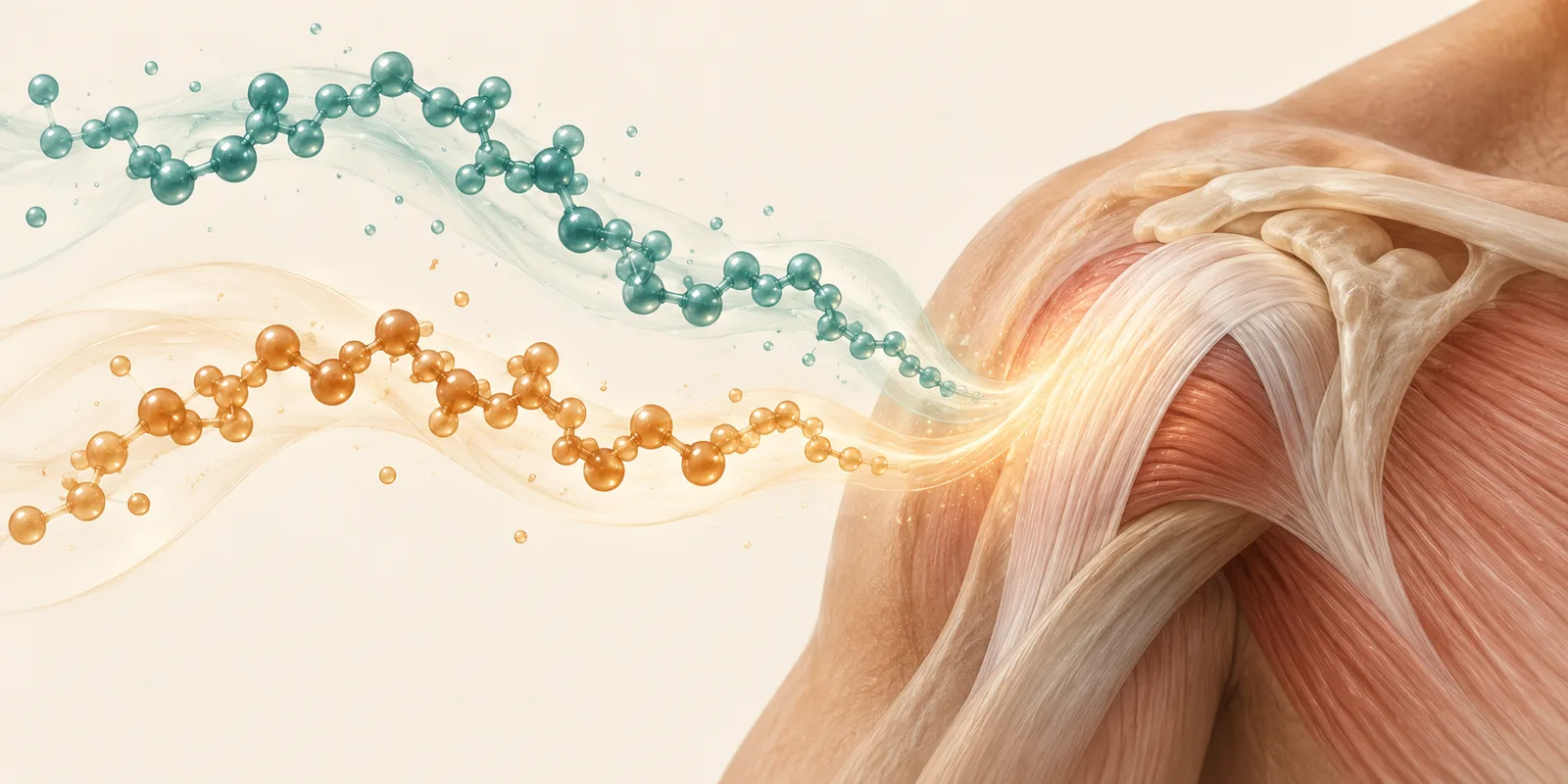
BPC-157 is a synthetic chain of 15 amino acids. TB-500, as characterized in the US Food and Drug Administration's technical review (https://www.fda.gov/media/193349/download), is an acetylated seven-amino-acid fragment of the larger thymosin beta-4 molecule. Online discussions often call the fragment and the full molecule by the same name. They are chemically different. Research on one cannot automatically establish the effects of the other.
The combination story usually runs like this: BPC-157 is expected to help an injured area locally, while TB-500 is expected to support a wider repair response. That is a proposed reason for pairing them. No human trial has tested whether those proposed roles actually complement one another. A sensible reader can understand the appeal while leaving the biological claim open.
What favorable firsthand accounts actually describe
One Reddit writer described a shoulder that had limited pressing exercises for more than six months. After using a BPC-157 and TB-500 blend for four weeks, the writer said the pain had improved substantially, though it had not disappeared immediately. Several months later, the writer reported returning to shoulder and chest pressing without pain (the original shoulder account). That is a meaningful personal outcome: doing valued activities again. The post does not include imaging before and after use, a comparison period, or a way to separate the blend from the passage of time and changed training.
A commenter in a longer knee-pain discussion described relief after using both peptides and said the knee was eventually pain free. Another person in the same discussion reported only about 15 percent improvement after nearly 90 days with the blend (the knee-pain discussion). These accounts sit beside each other on the same page. Reading both gives a more honest picture than selecting the most dramatic success.
In another thread, a 68-year-old commenter described going from severe difficulty walking to playing with children again after five weeks of BPC-157 and TB-500. The same person said exercise and major dietary changes happened during that period (the firsthand comment thread). The report conveys why this topic attracts attention. It also illustrates why the improvement cannot be assigned to the peptides. Changes in activity, food intake, time, and other care all occurred in the same window.
These posts are self-selected. People with a striking result may be more likely to post than those with no change. Products may differ in identity and purity. An anonymous account seldom includes a confirmed diagnosis, a consistent pain scale, or follow-up long enough to know whether improvement lasted. None of that means the writer is dishonest. It means the story answers a narrower question: what that person says happened.
The less satisfying stories matter too
An active forum member wrote a detailed account of a calf injury. BPC-157 alone produced little noticeable change for that person. A later period using the combination felt different, but the writer also described sweating and a flu-like feeling during the first two weeks (the 50-day account). The account is unusually useful because it reports both an apparent benefit and an unpleasant experience. It still cannot isolate a peptide effect: the two periods happened at different stages of recovery, without blinding or a control.
A Reddit user with elbow tendinitis reported no improvement on one side and some improvement on the other after six weeks of BPC-157 alone, while continuing physical therapy and limited golf. Replies urged adding TB-500, but the original writer pointed out that improvement could reflect therapy or time (the elbow discussion). The suggestion to add another substance when the first does not clearly work is common online. It is a hypothesis, not a demonstration that the pair is stronger.
Some accounts involve symptoms serious enough to deserve medical attention. The FDA's BPC-157 review (https://www.fda.gov/media/193343/download) describes an adverse-event report after use of a research-labeled BPC-157 and TB-500 blend. A report cannot establish that the product caused the reaction or how often such events occur. It does show why claims that the pair is known to be safe outrun the available evidence.
What the small human report can tell us
The 2021 knee-pain chart review by Lee and Padgett (https://pubmed.ncbi.nlm.nih.gov/34324435/) identified 17 people who had received injections into a painful knee and reached 16 by phone. Twelve had received BPC-157 alone; four had received BPC-157 with what the paper called thymosin beta-4. Eleven of the 12 in the first group and three of the four in the second reported improvement.
Those numbers are interesting but easy to overread. Four people are too few to determine whether adding the second peptide helped. The groups were not randomized. There was no placebo comparison, no standard measure of function, and no imaging to confirm tissue repair. The researchers relied on memories of pain before treatment, and follow-up timing varied. The paper did not adequately establish whether the second product was full-length thymosin beta-4 or the smaller TB-500 fragment. A difference between 11 of 12 and three of four cannot be treated as a head-to-head result.
The report can support one limited statement: some patients said their knees felt better after these injections. It does not establish that the pair heals meniscus or ligament damage, avoids surgery, or outperforms a single peptide. Readers interested in BPC-157 alone can also read our BPC-157 evidence review, which explains the broader human and animal record.
The rat study directly tested the combination
The 2026 Biçer experiment (https://pubmed.ncbi.nlm.nih.gov/42542926/) is unusually relevant because it included four groups in one design: untreated controls, BPC-157 alone, TB-500 alone, and both together. Thirty-two young male rats underwent the same Achilles tendon cut and surgical repair, with eight assigned to each group. Four tendons per group were used for a mechanical test and four for tissue analysis after about four weeks.
The mechanical test asked how much force the repaired tendon could withstand before failure. The TB-500 group did better than controls on that measure. The combined group did not show a statistically reliable advantage over controls or either single-peptide group. Under the microscope, the TB-500 group and the combined group showed better scores on one tissue-organization scale than controls. The combination again did not outperform the individual substances. The authors' full report (https://jointdrs.org/full-text/1851) states that the pairing did not provide an additive benefit in this experiment.
That result does not prove the combination can never help. The study was small, assessed one type of injury at one early time point, and tested a particular schedule in healthy young male rats. Mechanical strength was measured in just four tendons per group. Rat tendon repair is also not the same as a person's chronic shoulder pain, back pain, or gradual return to sport. The value of the experiment is narrower and important: when researchers put the pairing to a direct comparison, the expected extra benefit did not appear.
The identity of TB-500 deserves another pause. The study identifies a commercial product but also describes TB-500 as synthetic thymosin beta-4. The FDA distinguishes the seven-amino-acid fragment from the full 43-amino-acid peptide. The published methods do not resolve every question about the administered molecule for a reader trying to compare it with a vial advertised online. That uncertainty weakens any leap from the rat result to a specific commercial blend.
Why people still choose to combine them
The best explanation is practical rather than proven: people hope two plausible approaches will cover more of the recovery process than one. Someone with several painful sites may find the idea of a broader effect attractive. Someone who tried BPC-157 alone without a clear result may hope TB-500 fills a missing piece. Some users simply follow advice from a trusted training community or clinician.
The testimonies show these motives clearly. They also show that a blend makes interpretation harder. If pain improves, neither the user nor the reader can tell which ingredient mattered. If an unwanted effect appears, the same uncertainty applies. Adding a second experimental substance raises the number of unknowns, especially when the contents and quality of a product cannot be confirmed from its label or a social-media recommendation.
Full-length thymosin beta-4 has been studied in humans for some conditions. Those findings should not be casually transferred to TB-500. The FDA review (https://www.fda.gov/media/193349/download) states that it found no clinical studies assessing human exposure or safety for TB-500 itself. That is a central gap for a combination marketed around bodily repair.
A useful way to read a recovery testimonial
Ask what changed besides the peptide. Did the writer start physical therapy, reduce training load, sleep more, eat differently, or undergo surgery? Was the injury diagnosed with imaging, or guessed from symptoms? Did the post describe pain relief, restored function, or verified healing? Those are different outcomes. A person can feel less pain before a tendon is ready for heavy loading.
Do not copy a dose or injection location from a comment. The posts use inconsistent products and schedules, and no validated human combination regimen exists. Injecting a substance near an injury does not itself prove that it reaches the damaged tissue or improves repair. New swelling, fever, worsening pain, weakness, or loss of function calls for proper assessment, especially after an injection or a significant injury.
Where this leaves an interested reader
The online accounts explain why BPC-157 and TB-500 are paired: some people regain activities they had missed, and they connect that improvement to the blend. Other users see little benefit or feel worse. A small uncontrolled human knee report and one short rat tendon experiment cannot settle who, if anyone, benefits from the combination. The rat study did not show that the pair was better than either peptide alone.
For now, the honest case for combining them is a personal hope supported by anecdotes and biological ideas, not a measured advantage in people. Anyone weighing that choice should know exactly which molecule is being discussed, recognize that product identity and safety remain uncertain, and avoid treating less pain as proof of repaired tissue. Better human research would compare the combination with each component and with a control, follow function and injury outcomes over time, and report adverse events carefully. Until that exists, testimonials can help us understand the appeal, but they cannot supply the missing answer.