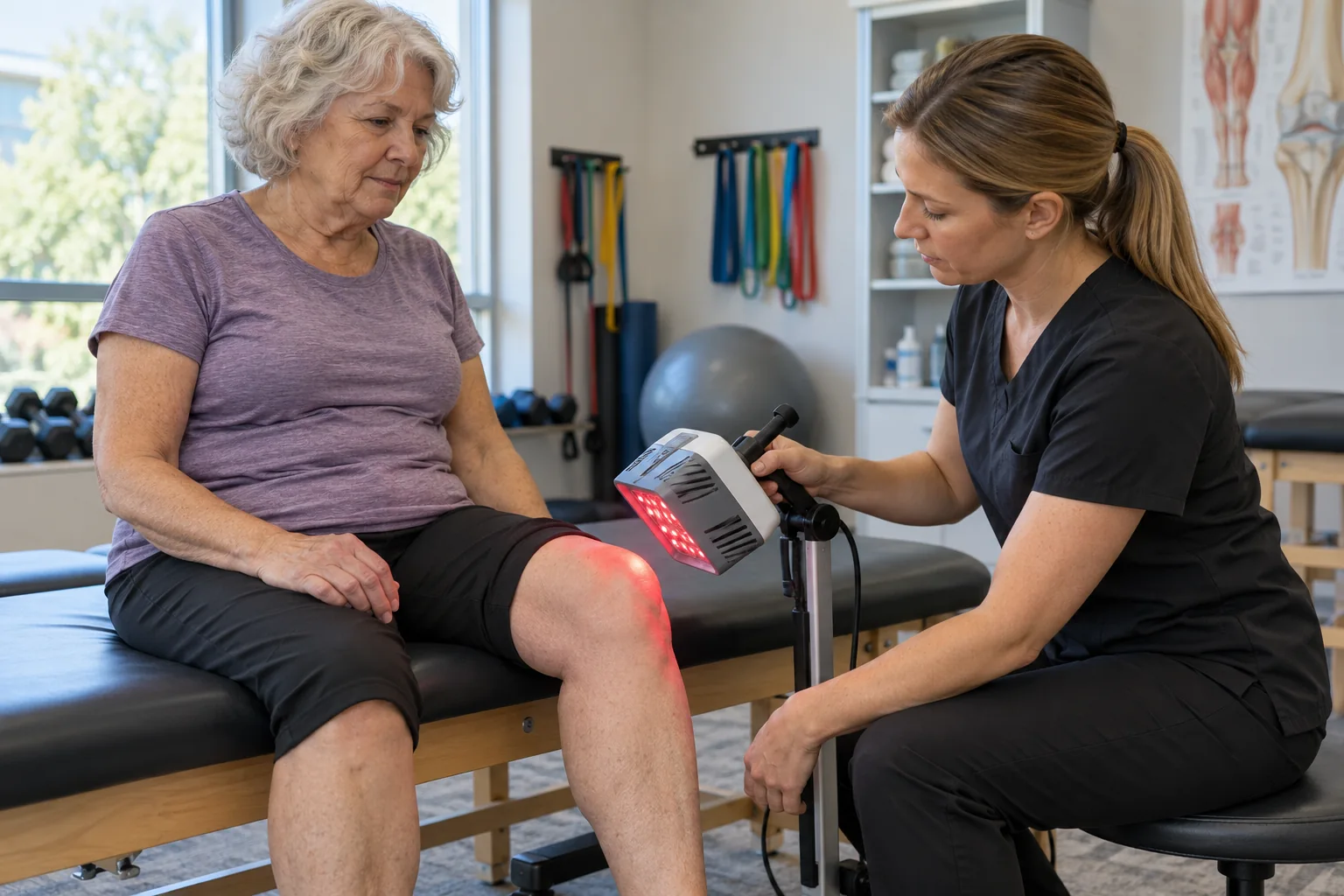
Light therapy may reduce knee osteoarthritis pain for some people, but the human trials do not support a simple “buy any red lamp” recommendation. A recent small sham-controlled trial reported less pain after a carefully specified near-infrared laser treatment. A larger trial found no extra benefit when light therapy was added to a strengthening program. The difference between those results is the story: the device, dose, comparison, and outcome determine what a study can say.
Knee osteoarthritis means that the whole joint, including cartilage, bone, and surrounding tissues, has changed over time. Pain can vary from day to day and is not a direct readout of how much cartilage remains. People searching for a non-drug way to feel more comfortable often encounter red-light panels, wraps, handheld devices, and clinic lasers advertised with the same language. They are not interchangeable in a clinical trial.
What does light therapy mean here?
Researchers usually call the method photobiomodulation. It uses relatively low-power red or near-infrared light, often from a laser or light-emitting diode. The device is placed near or against selected points around the knee for a specified time. In theory, light absorbed by tissue may influence cell signaling and inflammation. A laboratory mechanism, however, does not prove that a person will walk farther or hurt less.
Wavelength, output power, energy delivered at each point, number of points, frequency of visits, and treatment length can all differ. Light at 790 nanometers is near-infrared, although many people call the whole category red light. A decorative red bulb or a broad consumer panel may emit a different amount of usable light at the knee than a professional device used in a trial. The color seen by the eye is not enough to reproduce a research protocol.
The other difficulty is blinding. Participants can expect improvement when a device glows and someone treats their knee. A sham device that looks and feels similar helps researchers test whether active light adds benefit beyond the appointment and expectation. Pain questionnaires remain valuable because pain is the symptom people want to relieve, but they are also sensitive to context.
The encouraging 2025 trial
A 2025 knee osteoarthritis trial (https://pubmed.ncbi.nlm.nih.gov/40545487/) initially enrolled 73 people. Eight withdrew, leaving 65 in the final analysis. Researchers assigned participants to active photobiomodulation, a sham treatment, or a no-treatment control. The active group received a 790-nanometer laser delivering 4 joules at each of nine knee points. A joule is a unit of energy; the important point for readers is that the dose was defined, not simply “a little red light.”
The active group reported less pain than the sham and control groups after treatment. Measures of symptoms and daily function also improved within the active group. This is a reason to study the method seriously. It does not show that a different wavelength, a lower-power home wrap, or a single session will do the same. The small final sample and withdrawals widen uncertainty about the size of the benefit.
The paper's abstract does not give every detail a consumer would need to copy its schedule or judge durability. Before translating the result into buying advice, the full methods and longer follow-up need checking. This draft deliberately does not turn the nine treatment points into a home protocol. The trial was conducted under research conditions with a defined device.
The larger trial that found no extra gain
Another randomized study (https://pubmed.ncbi.nlm.nih.gov/37572382/) assigned 127 people with knee osteoarthritis to strengthening exercise alone, exercise plus active light therapy, or exercise plus placebo light therapy. Treatment was delivered three times weekly over eight weeks. Researchers measured pain, physical function, and quality of life after treatment and again at three and six months.
All groups improved compared with where they started. Yet the groups did not differ in a way that showed extra benefit from active light. This is an important comparison. If someone improves after receiving both exercises and light, the improvement cannot automatically be credited to the lamp. In this trial, active light did not add a detectable advantage to a strengthening program.
The result does not prove that light can never help. It tests a particular protocol, in a particular group, when everyone already had a meaningful exercise program. It does show why headlines about a stand-alone light treatment should be read beside trials of real-world combinations. For someone already doing knee-strengthening work, the added cost and visits deserve scrutiny.
What do all the trials together suggest?
A 2024 review (https://pubmed.ncbi.nlm.nih.gov/38775202/) examined ten placebo-controlled knee studies with 542 participants. Across six trials that measured pain at rest, the average reduction compared with placebo was about 0.7 points on a ten-point scale. The reviewers judged the certainty of that result very low because the trials had unclear or high risk of bias and differed in important ways. A movement test called Timed Up and Go did not show a clear benefit in the small number of trials that reported it.
The difference between statistical detection and a noticeable personal change matters. A 0.7-point average advantage might be meaningful to some people and negligible to others. An average can also hide people who respond more or less. The review did not establish a dependable formula for choosing the right home device or predict who will benefit.
The review is a map to the original studies, not a substitute for them. Its authors specifically noted the need for more rigorous trials and better dose guidance. The 2025 study appeared after the review's search period, so it adds a newer encouraging result without removing the older uncertainty.
Laser, LED panel, or wrap?
A clinic laser can deliver a measured dose to particular points. A home LED panel spreads light over a larger area. A wrap contacts the skin but may have a different mix of wavelengths and power. Marketing often borrows results from professional laser trials and applies them to a device whose output has not been tested in people with knee osteoarthritis. That leap is unjustified.
If a device is advertised using a study, find the exact paper. Check whether the trial used the same model, wavelength, treatment schedule, and outcome. A picture of a red knee next to the word “clinically proven” is not enough. Ask whether the study compared active and sham light, and whether the results lasted after treatment ended. These questions can save money even if you decide to try the approach.
Terms such as infrared, near-infrared, low-level laser, and red LED are sometimes used loosely. Near-infrared light is largely invisible, so the glow you see may not represent the treatment wavelength. “More powerful” is not automatically better: research protocols use a dose range, while excessive exposure has not been shown to solve the problem. Avoid translating a study's joules per point into an unsupervised home routine without knowing how that device measures output.
What a useful trial would tell us next
An especially helpful future study would compare a clearly described home LED device with an indistinguishable sham device, while both groups follow the same activity plan. It would enroll enough people to detect a change that matters in daily life and measure walking, stairs, sleep disrupted by pain, and adverse effects over several months. That is closer to the decision a reader faces than a short clinic-only test.
Researchers could also report whether baseline pain level or knee condition changes the response. At present, the literature does not offer a reliable “best candidate” profile. When a sales page claims that a specific device regenerates cartilage, look for direct human imaging and long-term functional evidence. The trials summarized here mainly measured pain and function. They did not prove cartilage regrowth.
Safety and practical decisions
Light devices are often described as harmless because they are noninvasive. Eye exposure still matters, especially with lasers and bright near-infrared sources. Follow device instructions and use appropriate eye protection where required. Some people have light-sensitive conditions or take medicines that increase sensitivity. Burns or irritation can occur if a heat-producing device is used carelessly. A therapy that feels gentle should still have a clear safety manual.
Knee pain deserves an assessment if it follows injury, comes with severe swelling or fever, or suddenly prevents weight bearing. A device should not be used to explain away a new alarming symptom. For ongoing osteoarthritis symptoms, a person may consider light therapy as an optional addition after understanding the uncertain average benefit and cost. The 127-person trial shows that a structured strengthening program can improve outcomes without an added light effect.
Our Qigong beginner guide explains another gentle movement option, with separate evidence for different symptoms. Choosing what you can sustain matters. If you do try light therapy, write down a simple baseline, such as pain while climbing stairs, and decide in advance what change would make the cost worthwhile. That is more informative than relying on a vivid first-session impression.
Red or near-infrared light for knee osteoarthritis is a plausible and actively studied option. The strongest honest claim today is narrower than most advertising: some protocols reduced pain in small trials; a larger trial found no added benefit alongside exercise; the pooled evidence is uncertain. That leaves room for future research and for an individual's preference, without selling an unproven miracle.