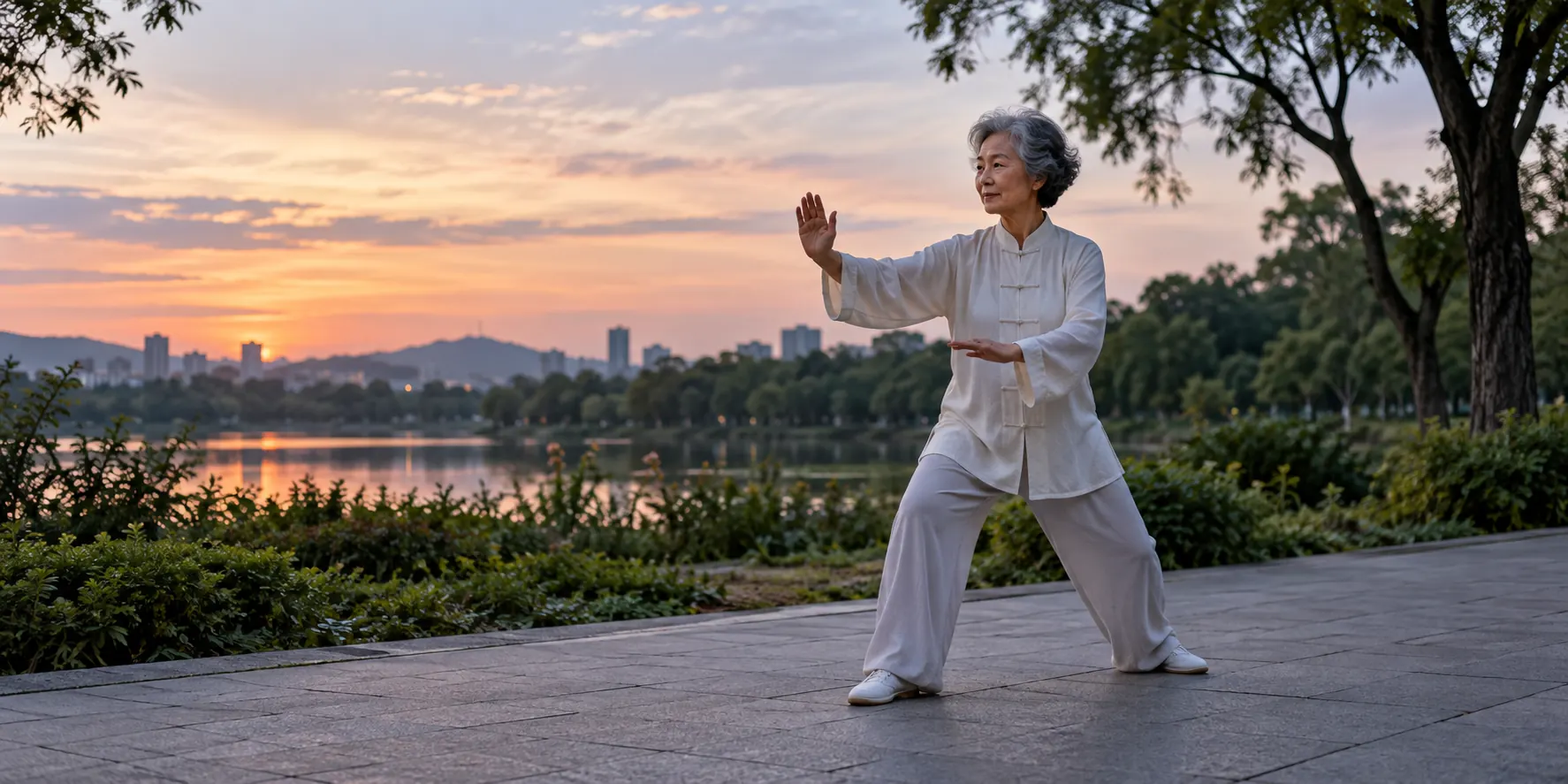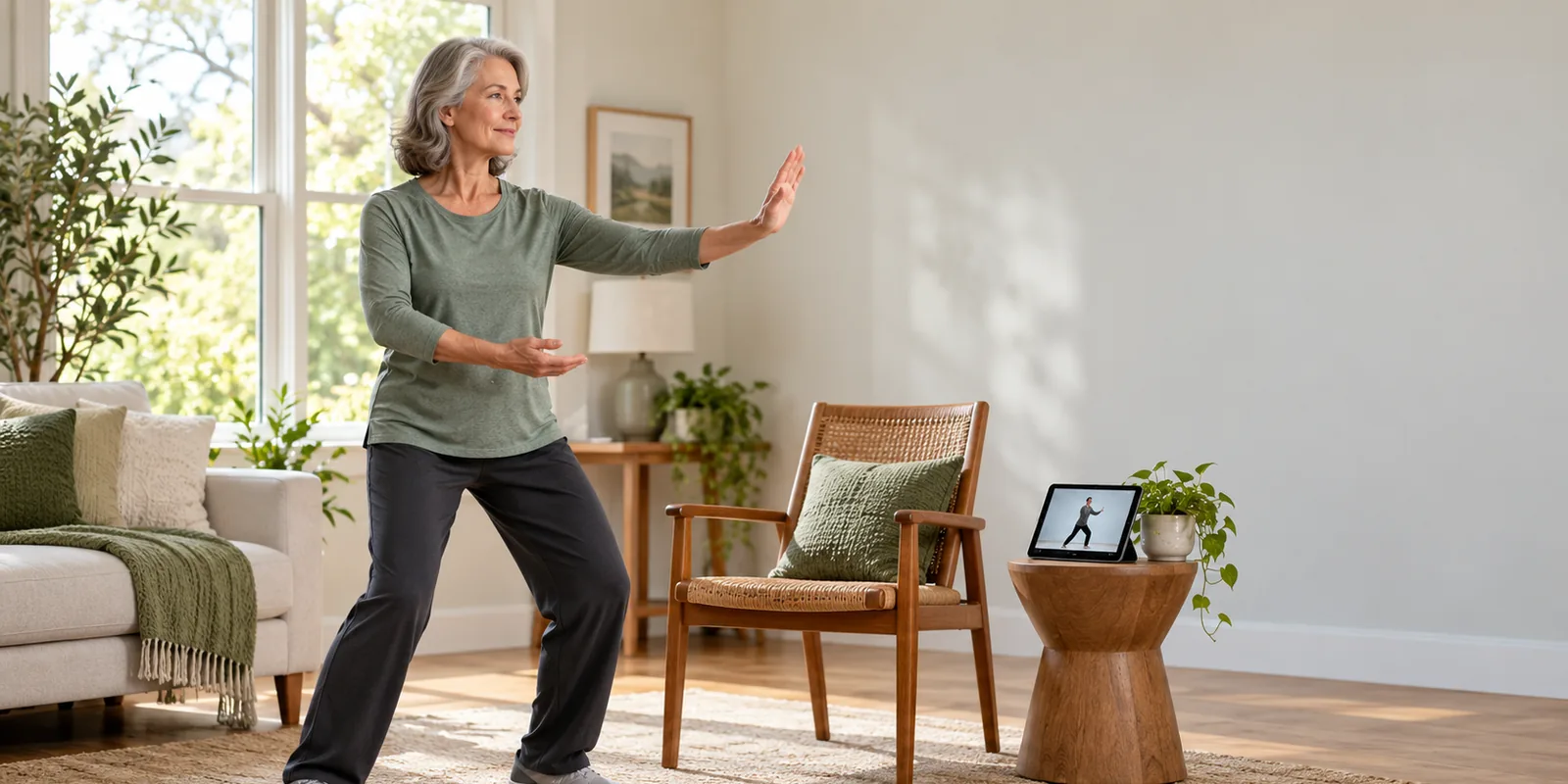
A 12-week tai chi video program helped adults with knee osteoarthritis report less pain while walking and less trouble with everyday activities than online education alone. The difference was modest on average, but more people in the tai chi group reached the trial's threshold for a meaningful personal improvement. The 2026 RETREAT randomized trial (https://pubmed.ncbi.nlm.nih.gov/41143827/) tested a specific home program, not every tai chi class or video available online.
That matters if sore knees make travel difficult. A structured home program may be practical, but how much of the result came from tai chi movements, regular exercise, or the program's reminders and expectations?
What the home program involved
Tai chi combines slow, controlled movement with attention to posture and breathing. For someone with painful knees, the useful feature is that movements can be adapted to a comfortable range. A gentle routine still asks the legs to support weight and shift it from side to side. That makes it a form of exercise, rather than a passive treatment. Readers new to the practice can start with our introduction to tai chi.
The RETREAT team built a program called My Joint Tai Chi for people with knee osteoarthritis. It offered one new prerecorded, 45-minute lesson each week for 12 weeks. Participants were asked to do that week's lesson three times. An experienced instructor demonstrated a modified ten-form Yang-style sequence with a warm-up and cool-down. The lessons began with simpler movements and added complexity gradually. The researchers also encouraged use of a phone app that sent messages to help people keep exercising. The full trial report (https://jamanetwork.com/journals/jamainternalmedicine/fullarticle/2840563) describes both parts of this package.
The comparison group could use an online site explaining osteoarthritis and the benefits of exercise. The tai chi group saw that same information, plus the lessons, tai chi material, and app encouragement. Random assignment helps balance differences between the groups at the start. The comparison can therefore test whether offering this complete program made a difference beyond giving people written information. It cannot establish that tai chi is better than walking, strengthening exercises, or a supervised class, because neither group was assigned one of those activities.
Who was in the trial?
Researchers in Australia screened 2,106 people and enrolled 178. Half were assigned to each group. Participants had knee pain for at least three months, pain on most days during the previous month, and walking pain of at least four on a zero-to-ten scale in the previous week. They met clinical criteria for knee osteoarthritis and needed internet access at home. The average age in each group was about 61 or 62 years, and most participants were women. These details appear in the RETREAT paper (https://pubmed.ncbi.nlm.nih.gov/41143827/).
The entry rules make the results most relevant to adults with ongoing, noticeable walking pain who can use a web program. The study did not require an X-ray for everyone. A person with a new knee injury, a different cause of swelling, limited internet access, or much milder symptoms may have a different experience. Clinical diagnosis can be appropriate for osteoarthritis, but persistent or changing knee symptoms still deserve an individual assessment when their cause is uncertain.
Both groups could pursue other care during the trial. Many participants reported other exercises or treatments, including massage, strengthening work, and walking. That is common in daily life and helps the trial resemble ordinary choices. It also means the result describes adding the online tai chi package to what people were already doing, rather than an isolated tai chi treatment under tightly controlled conditions.
How much did walking pain change?
Walking pain was one of two main outcomes. Participants rated their average knee pain while walking during the past week from zero, meaning no pain, to ten, meaning the worst pain possible. Both groups began at an average of 6.1. After 12 weeks, the education group averaged 4.8 and the tai chi group averaged 3.5. Their average improvements were 1.3 and 2.7 points, respectively. The difference in improvement was 1.4 points in favor of the tai chi package, with a statistical interval from 0.7 to 2.1 points. The published results table (https://jamanetwork.com/journals/jamainternalmedicine/fullarticle/2840563) gives these figures.
An average hides varied experiences. Before the trial began, the researchers set 1.8 points as a threshold for a personally important improvement in walking pain. At 12 weeks, 60 of 82 people with outcome data in the tai chi group reached it, compared with 41 of 88 in the education group. That is 73 percent versus 47 percent. It does not mean 73 percent became pain free. A person could improve substantially and still feel pain on stairs or during a long walk.
The average between-group difference of 1.4 points was just below that 1.8-point threshold. The threshold describes change within one person's pain score, so it should not be used as a rigid pass-or-fail rule for the group comparison. The individual responder figures add useful context. Together, the two measures support a real short-term symptom benefit, while leaving room for some people to gain little or nothing.
What about everyday function?
The second main outcome asked about difficulty with activities such as rising from a chair and moving around. It used the WOMAC function scale, where zero means no difficulty and 68 means the most difficulty. The tai chi group's average score fell by 12.0 points; the education group's fell by 6.9. The difference in change, adjusted in the trial analysis, was 5.6 points in favor of tai chi. Its statistical interval ran from 2.3 to 9.0 points. The 2026 trial (https://pubmed.ncbi.nlm.nih.gov/41143827/) reported that 72 percent of people with function data in the tai chi group reached the prespecified six-point improvement threshold, compared with 52 percent in the control group.
Function was reported by participants, not measured with a timed walk or a stair test. A lower questionnaire score can reflect a worthwhile change in daily life, but it does not prove that knee tissue healed or that leg strength increased. The trial did not measure cartilage repair, and a 12-week symptom study cannot show that an exercise prevents later joint damage.
Several other questionnaires favored the tai chi program, including knee-related quality of life and confidence in balance. Those findings are helpful supporting details, not independent proof that every aspect of health improved. The trial did not find a clear reduction in use of oral pain medicine for the knee. Fear of movement and positive mood also did not show a clear between-group difference in the published results table (https://jamanetwork.com/journals/jamainternalmedicine/fullarticle/2840563). These neutral outcomes keep the article's conclusion focused on pain and reported function.
Did people keep up with the lessons?
The plan called for three sessions each week. Among people who supplied practice information, the reported average was roughly two and a half days a week over the study. That suggests the program was feasible for many people, but the count came from participant reports. It was not a verified measure of how long they practiced or how accurately they moved. The trial's adherence and adverse-event table (https://jamanetwork.com/journals/jamainternalmedicine/fullarticle/2840563) also shows that fewer tai chi participants supplied some of these extra details than supplied the main pain and function scores.
At week 12, 170 of the 178 randomized participants supplied both primary outcomes. That is good follow-up for the main result. The missing data were uneven, however: 82 of 89 in the tai chi group and 88 of 89 in the education group supplied those outcomes. The researchers tested whether plausible patterns of missing results changed the answer, and their reported sensitivity analyses generally supported the main finding. They cannot know what every person who stopped responding would have reported.
No serious adverse event attributed to the intervention was reported. A few people in each group reported nonserious pain in the knee or elsewhere. No one stopped the trial because of a related adverse event. These numbers are reassuring for the 12-week program that was studied, but the safety questionnaires had fewer respondents than the main outcome surveys. They also cannot rule out uncommon problems or tell us what happens after many months of unsupervised practice.
How does this fit with other tai chi research?
The home trial did not begin from scratch. A 2016 randomized trial of 204 people with knee osteoarthritis (https://pubmed.ncbi.nlm.nih.gov/27183035/) compared instructor-led tai chi twice weekly for 12 weeks with a standard physical therapy program. Both groups improved substantially, and their main knee symptom scores at 12 weeks did not differ clearly. Participants were followed to 52 weeks. This supports tai chi as one reasonable exercise option, but it does not show that home videos perform exactly like an in-person instructor or that the two approaches are interchangeable for every person.
An earlier 2009 randomized study of 40 people (https://pubmed.ncbi.nlm.nih.gov/19877092/) compared tai chi classes with wellness education and stretching twice weekly. At 12 weeks, tai chi participants reported more improvement in knee pain and function and performed better on a chair-stand test. That performance measure adds something a questionnaire cannot, although a 40-person trial is small and the teaching format was different. Taken together, these trials suggest symptom relief is plausible across settings, while the size of benefit depends on the particular comparison and program.
Another online movement study points to a useful caution. A 2022 randomized trial of 212 adults (https://pubmed.ncbi.nlm.nih.gov/36122378/) found that an unsupervised yoga program improved reported function more than online education at 12 weeks, but its walking-pain difference was not clear and benefits were not maintained at 24 weeks. It is a separate practice, so its numbers should not be transferred to tai chi. It shows why short follow-up matters when people hope for lasting relief from home exercise.
What can a reader do with this finding?
If knee osteoarthritis makes a class hard to reach, a structured, gradual tai chi program is a reasonable option to discuss with a health professional who knows your mobility and balance. The tested program used adapted movements, instruction, warm-ups, and a schedule. Random clips of advanced forms may ask more of a painful knee. A stable chair nearby, clear floor space, and movements kept within a comfortable range can make home practice more manageable. Start slowly and adjust activity to symptoms, as the National Institute of Arthritis and Musculoskeletal and Skin Diseases advises in its osteoarthritis exercise guidance.
The study's My Joint Tai Chi program was available online when the researchers published their paper. Availability, cost, and access may change, so verify the current site before relying on it. Someone with frequent falls, a recent injury, a knee that locks, or pain that sharply worsens during movement may need an assessment and a more individual exercise plan before practicing without supervision. New redness, marked swelling, fever, or inability to bear weight also calls for medical evaluation rather than an exercise experiment.
Tai chi can be one part of living with knee osteoarthritis. A different option, electroacupuncture for knee osteoarthritis, has its own trial evidence and a different time and cost burden. The studies do not compare those two practices directly. For the home tai chi program, the clearest finding is better reported walking pain and function at 12 weeks than education alone. Whether that benefit lasts, and which part of the combined program produced it, remain open questions.