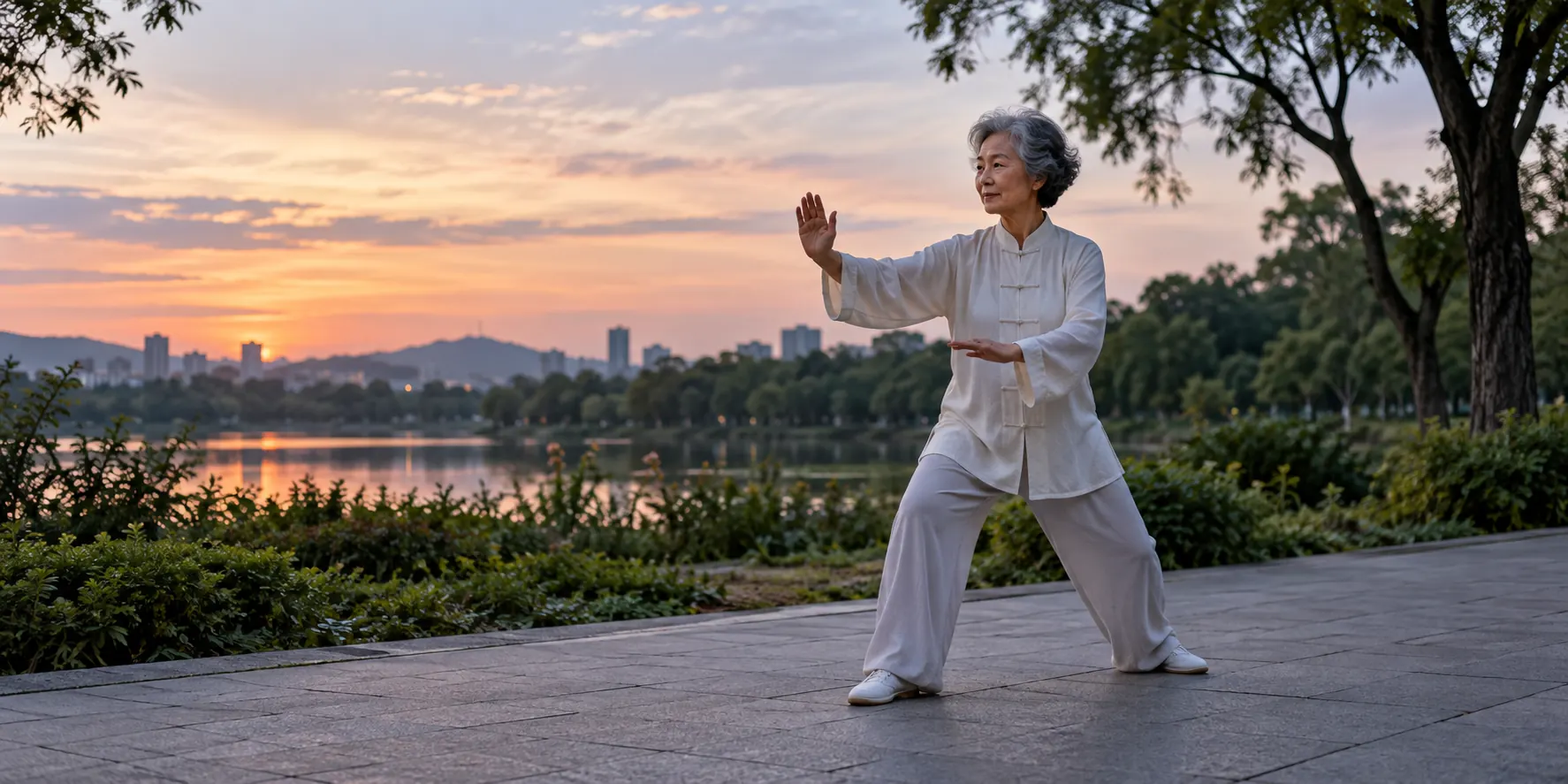
Adults who took supervised tai chi classes reported less insomnia after three months. The improvement was smaller than in the group receiving cognitive behavioral therapy for insomnia, or CBT-I. By month 15, the gap had narrowed enough to meet the trial's preset test for a clinically acceptable difference. Tai chi took longer to catch up in this group of older adults.
The BMJ trial (https://pubmed.ncbi.nlm.nih.gov/41297969/), compared a full tai chi program with group CBT-I and followed participants for a year after classes ended. A few movements at home were never tested.
What the two treatments involved
Tai chi combines slow, coordinated movement with attention to breathing and balance. In this study, trained instructors taught the 24-form Yang style. Participants attended two one-hour group classes each week for three months, a total of 24 sessions. Each class included a warm-up, about 45 minutes of practice, and a cool-down. Participants learned the movements with an instructor over 24 sessions.
For background on the practice, see our tai chi introduction or Wikipedia's overview of tai chi. The trial's sleep findings come from the clinical paper, not those background pages.
The comparison treatment was cognitive behavioral therapy for insomnia, often shortened to CBT-I. It teaches people to change habits and thoughts that keep sleep problems going. Its tools can include a regular sleep schedule, ways to respond when awake in bed, and a carefully planned reduction in time spent in bed. The study delivered CBT-I in group sessions on the same twice-weekly schedule as tai chi. A trained program is different from a list of general sleep tips.
The American Academy of Sleep Medicine guideline (https://pubmed.ncbi.nlm.nih.gov/33164742/) gives multicomponent CBT-I a strong recommendation for adults with chronic insomnia. That recommendation rests on many trials. It also advises against using sleep hygiene advice alone as the sole treatment. The trial therefore offers a direct comparison with a treatment already supported by many studies.
Who took part, and what was measured?
Researchers recruited 200 Chinese adults aged 50 or older in Hong Kong. All had chronic insomnia, meaning persistent trouble falling asleep, staying asleep, or waking too early, with daytime effects. One hundred were randomly assigned to tai chi and 100 to CBT-I. Random assignment helps balance differences between groups that might otherwise explain an outcome. The people teaching and receiving the classes knew which program they were in, but the assessors were kept unaware of group assignments.
Participants had moderate insomnia symptoms on average. The investigators excluded people with untreated sleep apnea, shift work, past CBT-I treatment, major illnesses that could strongly disturb sleep, and physical limitations that prevented tai chi. These exclusions helped make the comparison clearer. They also mean the results may not fit someone whose insomnia comes from an untreated breathing disorder or who cannot safely join movement classes.
The main measure was the Insomnia Severity Index, a questionnaire about perceived sleep difficulty and its effect on daily life. A lower score means fewer symptoms. The investigators measured it before classes, immediately after the three-month program, and at month 15, one year after the supervised sessions ended. Sleep diaries, sleep quality questionnaires, remission, and treatment response supplied additional information. The main outcome was a report from the participant, not a direct recording of sleep stages.
Therapy had the clearer early result
At three months, the tai chi group's insomnia score fell by about 6.7 points in the main per-protocol analysis. The CBT-I group's score fell by about 11.2 points. The difference between the improvements was about 4.5 points in favor of CBT-I. These figures come from the study's published results (https://pubmed.ncbi.nlm.nih.gov/41297969/), which give confidence intervals as well as averages.
The researchers had decided in advance that tai chi could be called noninferior only if the plausible gap in improvement stayed below four points on the scale. At month three, the upper confidence limit for the gap was 5.81 points, beyond that boundary. In plain language, the data did not rule out an early disadvantage larger than the researchers were willing to accept. Calling the treatments equally effective after three months would misstate the trial.
The remission figures point the same way. Among people assessed at month three, 56.1% in the tai chi group and 83.3% in the CBT-I group met the study's definition of remission. Remission is a defined research outcome, not a guarantee that someone will never have another bad night. The difference is still useful for anyone deciding whether rapid improvement is a priority.
Why the 15-month result needs careful reading
At month 15, the tai chi group's average score reduction was about 9.5 points, compared with about 10.2 points for CBT-I. The estimated gap was 0.68 points, and the upper confidence limit was 2.00 points. Because that limit stayed below the preset four-point margin, the study met its statistical definition of noninferiority at that time. The analysis that included all randomized participants with methods for missing data reached the same broad conclusion.
Noninferior means the plausible shortfall for tai chi stayed within the difference the researchers had agreed to accept at month 15. It does not mean the treatments are identical, that tai chi is better, or that every patient responds equally. The margin itself is a judgment about how much difference would matter. A reader may reasonably care about the stronger early CBT-I result even if the later scores came close.
The 15-month remission rates were 76.5% among assessed tai chi participants and 63.4% among assessed CBT-I participants. That difference did not meet the study's statistical threshold for a clear between-group result. It would be misleading to turn these two percentages into a claim that tai chi prevents more insomnia. This was a secondary outcome, and the trial was designed around the insomnia score comparison.
Some participants kept using what they learned after supervised sessions ended. At month 15, 31 of 85 assessed tai chi participants reported continuing tai chi practice, while 13 of 82 assessed CBT-I participants reported continuing its techniques. Continued practice may help explain the later pattern, but the trial did not randomly assign people to keep practicing or to stop. It cannot separate the effects of the original classes from later habits.
What other research adds
A separate randomized study in 320 older adults compared 12 weeks of tai chi, ordinary exercise, and a group receiving no new exercise program. It used a wrist device to estimate sleep over several nights. Both active groups improved sleep efficiency by about three to four percentage points over the control group after the program, and both spent less time awake after falling asleep. The objective improvements were modest, and tai chi did not clearly outperform conventional exercise on the main device-based measures. That original trial (https://pubmed.ncbi.nlm.nih.gov/33587135/) supports the idea that regular tai chi can help sleep, while leaving open how much of the benefit comes from movement generally.
An earlier trial in breast cancer survivors also compared tai chi with CBT-I (https://pubmed.ncbi.nlm.nih.gov/28489508/). Its participants and form of tai chi differed from those in the new Hong Kong study. The cancer-survivor trial is useful context, though its results may not carry over to every older adult with chronic insomnia. People also learned a different form of tai chi.
The 2025 trial measured perceived insomnia, which is important because insomnia is partly defined by a person's experience and daytime impairment. It did not establish that tai chi altered a specific sleep stage, repaired a biological defect, or prevented later disease. The earlier wrist-device study adds a different kind of measure, but wrist movement is still an estimate of sleep rather than a full laboratory sleep study.
Limits that affect a personal decision
The main trial came from one research center and involved Chinese adults aged 50 or older who could take part in group movement classes. A different teaching style, an unsupervised app, or a person with severe pain might have a different result. About 83% of participants completed assessments at each major follow-up. Missing responses matter in a trial that asks whether two treatments are close enough, particularly if people who dropped out slept differently from those who stayed.
Participants knew whether they were doing tai chi or CBT-I. Expectations and the social support of group classes could influence self-reported symptoms. Both groups received instructor time, which makes the direct comparison more informative, but the study had no third group with no treatment. It cannot say exactly how much of each group's improvement came from the specific method, group contact, or changes over time.
The researchers reported no adverse events during the intervention period. That is reassuring for the people enrolled, but 200 selected participants cannot reveal every possible problem. Tai chi still involves standing, turning, and shifting weight. Someone at risk of falls, with dizziness, or with a condition that limits movement should choose an appropriate setting and discuss modifications with a clinician or qualified instructor. People with suspected sleep apnea, severe daytime sleepiness, or worsening mood need an assessment of those problems rather than assuming a class addresses the cause.
A practical way to use the result
Someone seeking help for persistent insomnia can ask about CBT-I first. It has the stronger guideline backing and, in this trial, the larger early improvement. If access, preference, or ability to engage with CBT-I is a barrier, a supervised tai chi program may be worth considering as part of a broader plan. The study tested two hour-long classes each week for three months; it did not test a few minutes of tai chi as a quick fix on a sleepless night.
Keep expectations tied to the evidence. Tai chi may take time and continued practice to pay off, and its average result does not predict any one person's outcome. Track whether sleep and daytime functioning actually improve. If you use sleep medication, do not stop or change it because of this trial. A clinician can help work out whether the main problem is insomnia, another sleep disorder, medication effects, pain, or something else that needs its own treatment.
Readers interested in other mind and body practices can compare our qigong introduction and our meditation overview. Neither article establishes that those practices reproduce the tai chi results in this trial.
For someone interested in a movement practice, this trial supports trying a taught tai chi program and checking whether sleep improves over time. It also shows why the timing matters: CBT-I produced the larger improvement at three months, while the groups were closer a year later.