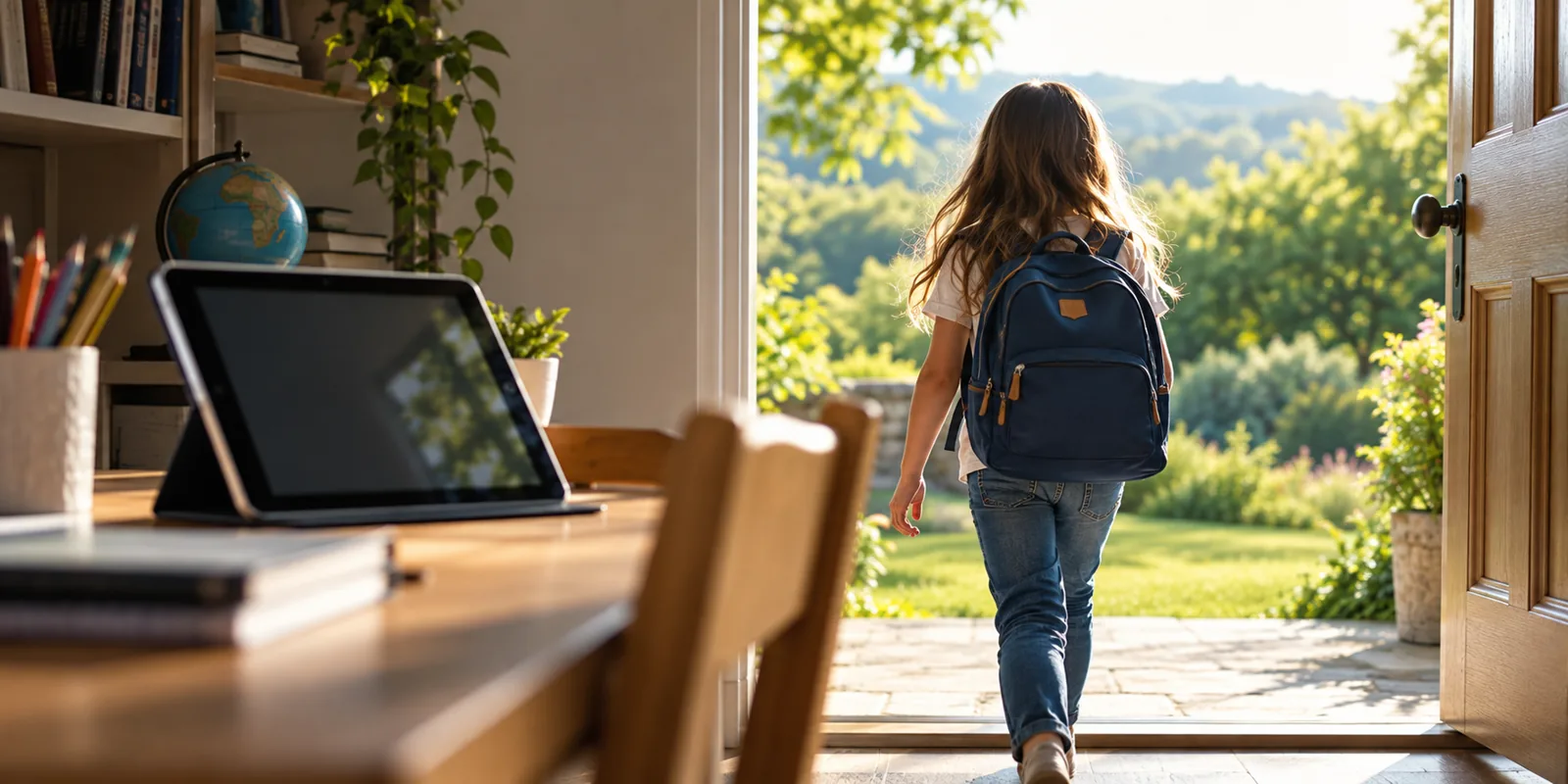
An extra outdoor break has better evidence for protecting a young child's developing eyesight than a pair of blue light glasses. In a school trial involving nearly 1,900 first-graders, children assigned an additional 40 minutes outdoors each school day developed nearsightedness less often over three years. A direct trial of blue light glasses found no eye strain advantage over ordinary clear lenses, although that glasses trial involved adults rather than children. The two studies answer different questions, and neither suggests that a child should ignore persistent eye symptoms.
That distinction matters when a student comes home rubbing their eyes after hours of schoolwork and screens. Eye strain is a short-term symptom. Myopia, or nearsightedness, is a change in how the eye focuses distant objects. Sleep is a third question. One product marketed for all three should be judged against research on each outcome separately.
What a blue light lens trial actually tested
Blue light is part of visible light. A tinted or coated lens can reduce some of the short-wavelength light entering the eye. That physical effect does not automatically mean less headache, better sleep, or protection from future eye disease.
In the Singh blue light lens trial (https://pubmed.ncbi.nlm.nih.gov/33587901/), researchers enrolled 120 people who already had symptoms while using computers. Each person received either blue-blocking or standard clear glasses, wore them through a two-hour computer task, and did not know which type they had. The team also varied whether a clinician spoke favorably or unfavorably about the glasses. This design helped separate a lens effect from expectations about the product.
After the computer task, symptom scores and an objective measure related to visual fatigue did not differ significantly between the lens groups. All 120 participants completed the trial, and no adverse events were reported. The finding is useful for the common claim that blue light glasses relieve screen eye strain. Its limit is equally clear: a two-hour test in symptomatic computer users cannot tell us what happens after years of wear, nor can it establish the result for a seven-year-old in a classroom.
There is another mismatch in the sales pitch. Claims that ordinary screens damage children's retinas are not established by clinical studies. The American Academy of Ophthalmology's digital-device guidance says the small amount of blue light from computer screens has not been shown to damage human eyes. Cell experiments using intense light do not answer whether everyday tablet use causes retinal disease in children. Buying a filter as insurance against that outcome goes beyond the evidence.
Outdoor light addresses a different problem
The strongest child-specific result concerns new myopia. In the Guangzhou outdoor-time trial (https://pubmed.ncbi.nlm.nih.gov/26372583/), investigators assigned 12 primary schools, rather than individual pupils, to an outdoor program or usual routines. The six intervention schools added one 40-minute outdoor class each school day. Families were also encouraged to spend more time outdoors after school. The comparison schools continued as before. In all, 1,903 first-graders entered the study, with an average age of about six and a half years.
The main outcome was whether a child without myopia at the start developed it during three years of follow-up. Among children eligible for that analysis, 30.4% in the outdoor schools developed myopia, compared with 39.5% in the comparison schools. That is a 9.1 percentage-point difference, or roughly nine fewer new cases per 100 children over three years in this trial. It is more informative than saying risk fell by about a quarter without giving the starting risk.
The researchers also measured changes in prescription strength and eye length. The outdoor group had a slightly smaller shift toward myopia in prescription strength. The difference in eye length was small and did not meet the trial's threshold for statistical significance. The trial therefore supports a reduction in new myopia diagnoses in these schools, with a more modest and less consistent picture for the biological measurements.
School assignment strengthens the comparison because families could not simply choose the program based on a child's eyesight. The study still cannot tell us which part of the package mattered most. It combined outdoor school time with encouragement at home, and school staff and families knew the assignment. The pupils lived in one Chinese city. The size of any benefit could differ where school schedules, baseline outdoor time, or myopia rates differ.
A larger school trial offers a useful check
The Shanghai outdoor-time trial (https://pubmed.ncbi.nlm.nih.gov/35779695/) assigned 24 schools and 6,295 children aged six to nine to usual time outdoors, an extra 40 minutes each school day, or an extra 80 minutes. Researchers measured whether children developed myopia over two years. During the second year they also used wrist-worn light monitors, which gave a more direct measure of exposure than a parent's memory alone.
The unadjusted proportion developing myopia was 24.9% in the usual-routine group, 20.6% in the 40-minute group, and 23.8% in the 80-minute group. After statistical adjustment, both outdoor groups had a lower incidence than controls. The 80-minute group's result was smaller than the 40-minute group's, so this trial does not establish that doubling outdoor school time doubles the benefit. The outdoor groups also had somewhat smaller changes in prescription strength and eye length.
Why might outdoor time help? Daylight is generally much brighter than indoor lighting, and time outdoors often interrupts sustained near work. Researchers have not fully separated those possibilities in children. The evidence does not require strenuous exercise: sitting, walking, or playing outside can all provide outdoor light. It also does not justify staring at the sun or skipping sun protection. For comfortable outdoor time, shade and appropriate clothing still matter; see our sun protection guide.
These trials studied prevention or slowing of myopia in primary school children. They did not show that outdoor time reverses an established prescription or replaces a child's glasses. A child who squints at the board still needs an eye examination, even if they spend plenty of time outdoors.
Eye strain deserves its own answer
Outdoor time is a reasonable break from close work, but the myopia trials were not tests of after-school headaches or dry eyes. One popular suggestion for those symptoms is the 20-20-20 rule: every 20 minutes, look about 20 feet away for 20 seconds. It is easy to try, but the exact numbers have not earned the certainty often attached to them.
In a small 20-20-20 experiment (https://pubmed.ncbi.nlm.nih.gov/36473088/), 30 young adults performed a demanding 40-minute tablet task under four break schedules, including no break and 20-second breaks every 20 minutes. Symptoms rose after the task under every schedule. The schedules did not significantly change symptoms, reading speed, or accuracy. This was a short laboratory task, so it cannot rule out a benefit from different breaks during a long school day.
Another 20-20-20 study (https://pubmed.ncbi.nlm.nih.gov/35963776/) followed 29 symptomatic computer users after software began prompting breaks. After two weeks, they reported fewer eye strain and dry-eye symptoms. The improvement faded a week after reminders stopped, and measured tear-film signs did not improve. Because everyone received the reminder and there was no separate control group, the change could reflect taking more breaks, using the computer less, expectations, or another factor. It would be inaccurate to describe this as proof that the exact 20-second schedule treats dry eye.
For a family, the sensible experiment is simpler: notice when discomfort begins, interrupt close work, look farther away, and adjust the screen so text can be read comfortably. A child can also blink fully and avoid holding a phone inches from the face. These are low-cost comfort steps, not proven substitutes for an eye exam. A headache may come from an uncorrected vision problem, dry eyes, or something unrelated to screen light.
Evening light and sleep are a separate question
Blue light can influence the body clock, so the idea of evening filters has a plausible basis. The leap from that mechanism to claiming that a particular pair of glasses will improve a child's sleep is much larger. Screen brightness, content, bedtime, and morning light all change along with the color of light a child sees.
A 2026 adolescent sleep trial (https://pubmed.ncbi.nlm.nih.gov/42008244/) illustrates the problem. It enrolled teens aged 16 to 19 who habitually fell asleep late on weekends. The 86 randomized participants were offered either monitoring or a two-week program that combined an earlier sleep schedule, morning bright-light glasses, and amber blue-blocking glasses for two hours before bed. Compared with monitoring, the combined program shifted measured body-clock timing earlier by about 45 minutes and extended weeknight sleep by about 47 minutes. That is encouraging for the whole program. Because the three changes happened together, it cannot tell us whether the amber glasses helped, or how much.
The study also involved older teens with late sleep, not all schoolchildren. A claim that every child needs a precise 90-minute screen curfew would require a different direct test. Families can still choose a calmer, dimmer evening routine, especially when a device keeps a child awake through messages or games. Watch whether a change actually improves sleep rather than assuming the color setting did all the work.
What to try before buying glasses
If the concern is preventing nearsightedness in a primary school child, make room for regular outdoor daylight. An extra outdoor period at school or after school is closer to what the successful trials tested than buying a lens coating. The trials support a useful direction, not a guaranteed number of minutes for every child. Comfortable shade is acceptable; the benefit did not depend on exposing bare eyes or skin to harsh midday sun.
If the concern is discomfort during screens, check the child's vision, screen distance, text size, glare, and opportunities to pause. Blue light lenses may be a personal preference, but the direct eye strain trial gives little reason to treat them as a proven fix. If a child already likes a pair, there is no need to make it a family battle. The more important question is whether symptoms persist.
If the concern is sleep, keep the experiment specific: choose a consistent bedtime and reduce bright, engaging screen use near it, then note whether falling asleep becomes easier. The adolescent trial supports a combined schedule and light approach for selected older teens. It does not isolate the glasses, and it is not evidence that a young child needs a special product.
Blurred distance vision, persistent headaches, eye pain, a new squint, or a child repeatedly moving very close to a screen deserves assessment by an eye-care professional. Outdoor light may lower the chance of new myopia; it cannot diagnose what is happening now. That is the useful split behind this topic: protect future vision with habits supported by school trials, and investigate symptoms rather than asking a tinted lens to explain them all.