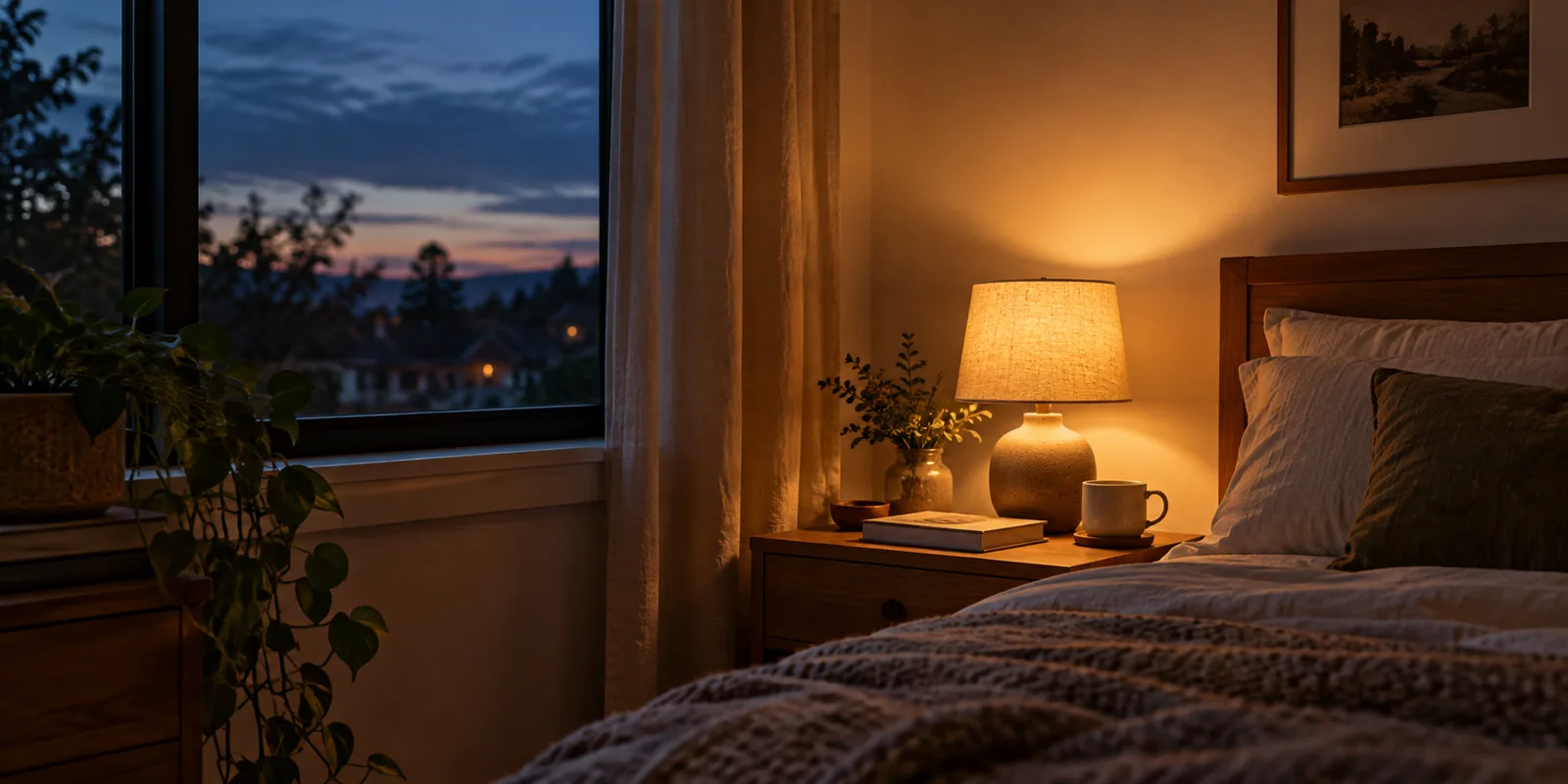
A dim, warm-colored LED is a reasonable choice for a lamp you use before bed. The strongest practical evidence favors reducing the amount of light reaching your eyes in the last part of the evening. A warm bulb may also reduce the short-wavelength light that affects the body's night signal. Neither its LED label nor its color alone guarantees better sleep.
This is an unusually useful question because people can change a room's lighting without buying a sleep treatment. A small shaded lamp, a dimmer, or a warmer setting on a bulb already in the house may be enough to change the evening environment. Research helps explain which changes have a plausible effect. It also shows why claims that all LEDs are harmful, or that one traditional bulb is the only healthy choice, are too broad.
Why evening light affects the body clock
Melatonin is a hormone that normally rises as the biological night begins. Light entering the eyes can delay that rise or reduce it while the light is on. Special retinal cells are particularly responsive to blue-green wavelengths. The response depends on the light's spectrum, its brightness at the eye, when it is seen, how long it lasts, and the person looking at it. A bulb's electrical power in watts tells you little about that exposure.
In the Gooley room-light study (https://pubmed.ncbi.nlm.nih.gov/21193540/), researchers analyzed melatonin profiles from 116 healthy adults aged 18 to 30 who spent at least five days in a clinical research unit. They compared evenings with ordinary room light below 200 lux against very dim light below 3 lux during the eight hours before scheduled sleep. Melatonin started later in 99% of the relevant comparisons and its nightly duration was shortened by about 90 minutes under room light. Light during usual sleep hours also suppressed melatonin by more than half in most measured trials.
That is strong evidence that ordinary indoor light can change a biological signal. It does not mean every living room produces the same effect, or that a 90-minute change in the hormone automatically causes 90 minutes less sleep. The study measured melatonin under controlled conditions. Its young, healthy participants do not represent every age group or person with a sleep disorder.
What happened when people changed light at home
A smaller experiment tested an action readers can actually take. In the Burgess home-light study (https://pubmed.ncbi.nlm.nih.gov/24918238/), eight healthy adults went through a dim week and a bright week, separated by five days. During the four hours before their usual bedtime, they minimized household light in one week and maximized it in the other. The order was counterbalanced. Their average evening exposure was about 3 lux in the dim condition and 65 lux in the bright condition.
Every participant's melatonin onset occurred later after the bright week, by an average of 63 minutes. Bedtime measured by a wrist activity device was about 14 minutes later, while wake time did not change. This study links a real home lighting change with body-clock timing, but eight people and two short exposure periods are too little to predict a long-term sleep benefit. A wrist device estimates sleep behavior; it is not a diagnosis of insomnia.
The Cain home-light study (https://pubmed.ncbi.nlm.nih.gov/33154450/) added a different view. Researchers used a wearable light sensor to examine household exposure and its relation to sleep. They estimated that nearly half the measured homes provided enough light for a 50% melatonin reduction in a typical sensitivity model. The predicted response in an average home still ranged from zero to 87% across individuals. Greater evening exposure relative to a person's usual level was associated with more wakefulness after bedtime. This observational association does not prove that changing a bulb will fix waking at night. The study also grouped lighting by source type in real homes, where brightness, fixtures, placement, and habits differ.
Together, these studies point toward an evening routine: lower the light where you sit before bed and keep the bedroom dark for sleep. The CDC's light and sleep guidance (https://archive.cdc.gov/www_cdc_gov/niosh/emres/longhourstraining/light.html) likewise advises dimming lights about two hours before bedtime if falling asleep is difficult. People who work nights or need to stay alert at unusual hours may need a different timing plan.
What the 2026 bulb comparison actually measured
The Teran bulb study (https://pubmed.ncbi.nlm.nih.gov/41565717/) examined 52 fixed-color household lamps from 14 manufacturers: warm and cool LEDs, warm and cool compact fluorescent lamps, and incandescent bulbs. The team measured each lamp's spectrum, then normalized the output for a comparison of roughly similar visible light. They fed those spectra into a model that estimates melatonin suppression for a 30 to 90 minute evening exposure. Four adjustable LEDs and eight light-filtering lenses were also examined.
The study's table gives median **modeled** suppression values of 12.1% for cool LEDs, 12.3% for cool CFLs, 3.6% for warm LEDs, 2.6% for warm CFLs, and 1.5% for incandescent bulbs under its chosen assumptions. The paper's abstract appears to swap the two cool-lamp numbers; the table lists cool LED as 12.1% and cool CFL as 12.3%. Either way, the practical comparison is between cool and warm light. The categories are not five groups of people whose melatonin was measured after using these bulbs.
The adjustable LEDs changed their modeled result substantially when set warmer. That does not show that an app-controlled bulb improves sleep, and it does not establish a universal safe Kelvin number. The authors explicitly note that the estimates assume a particular exposure duration and brightness and describe an average response. The measured lamps were a retail sample, not every product now on sale. A lamp placed close to the face, a bright ceiling fixture, or several lights used together can change exposure more than a modest difference between warm bulb types.
One 2017 human crossover trial (https://pubmed.ncbi.nlm.nih.gov/28472667/) gives the spectrum argument a direct test. Sixteen healthy adults experienced a blue-depleted LED and a standard 4100 K fluorescent source at the same 50 lux on separate inpatient days. Each exposure lasted eight hours before a fixed bedtime, and each was compared with a preceding dim-light day. The blue-depleted LED produced less melatonin suppression and lower objective alertness measures than the fluorescent light. Subjective sleepiness was similar. Total sleep time, sleep efficiency, and slow-wave sleep measures did **not** differ significantly between light conditions; the investigators also found an order effect on sleep results.
That is a useful warning against turning a hormone result into a promised night's sleep. It was a short study with selected lighting systems and 16 participants. An earlier crossover study in 16 healthy young men (https://pubmed.ncbi.nlm.nih.gov/21298068/) compared cool and warm CFL light and incandescent light at 40 lux for two evening hours. Its 6500 K cool CFL condition suppressed melatonin more and increased alertness compared with warmer conditions. The result supports the role of spectrum, but it did not test every modern LED or long-term sleep quality.
How to choose a bulb for an evening room
Start with the light you actually need. A lamp that lights a page or walking path can be much dimmer than a ceiling fixture lighting the whole room. Put a shade between the bright bulb and your eyes, use fewer lamps late in the evening, and lower a compatible dimmer if available. Keep enough light to move safely, especially on stairs or for anyone at risk of falls.
For an evening bulb, look for a warm appearance on the package, often around 2700 K or lower, and choose a lower lumen output if the fixture permits. Kelvin describes color appearance; lumens describe total visible output. Neither number alone measures the blue-green light that reaches your eyes. The U.S. Department of Energy's bulb guidance (https://www.energy.gov/cmei/femp/purchasing-energy-efficient-light-bulbs) explains these labels and notes that warm LEDs are available with much lower energy use than equivalent incandescent bulbs. A tunable LED can serve a brighter daytime room and a warmer, dimmer evening room if its controls are convenient. Check that a bulb is rated for the fixture and dimmer.
There is no need to replace every LED with an incandescent bulb. The measured 2026 sample found a warm LED much closer to the warm-light group than to a cool LED on its modeled measure. An incandescent bulb did have the lowest modeled value in that test, but it used considerably more electricity to provide comparable visible light. A warm LED is a sensible practical balance for many households. If an existing warm lamp is comfortable and suitably dim, a new bulb may have little to add.
Keep daytime light in the picture. A dark home all day followed by bright light late at night gives the body a poor contrast between day and night. The CDC's sleep guidance (https://www.cdc.gov/niosh/bulletin/2020/sleep.html) encourages daytime outdoor light and a dimmer environment before bedtime. Our article about blue light glasses and outdoor time for children addresses a different question: outdoor light and myopia in schoolchildren. It should not be read as a trial of bedroom bulbs or as evidence that glasses treat insomnia.
Compact fluorescent bulbs and mercury
A compact fluorescent lamp, or CFL, contains a small amount of mercury sealed inside its glass tube. That fact matters for handling and disposal, not because an intact lamp releases its contents during normal use. The U.S. Environmental Protection Agency's CFL guidance (https://www.epa.gov/mercury/compact-fluorescent-light-bulbs-cfls) explains the mercury issue and recycling options. CFL light also comes in warm and cool versions, so mercury content and evening color are separate decisions.
If a CFL breaks, follow the EPA's cleanup instructions (https://www.epa.gov/mercury/cleaning-broken-cfl). Have people and pets leave, open an outside window or door for 5 to 10 minutes, and shut off forced-air heating or cooling before collecting the pieces. Use stiff paper, sticky tape, and damp wipes. Do not vacuum first, because it can spread powder or vapor. Seal the waste, move it outdoors promptly, and check local disposal rules. The EPA notes that a CFL holds far less mercury than a mercury thermometer, while still recommending careful cleanup. LED bulbs avoid this particular mercury-in-glass issue.
A practical evening test
For a week, try using a small warm lamp instead of bright overhead lighting during the last hour or two before bed. Keep the bedroom dark after lights out. Notice whether the room remains safe and comfortable and whether your bedtime or night waking changes. A personal trial is a way to judge convenience, not proof that a specific bulb treated a sleep condition. Avoid reading the 2026 model percentages as a prediction for your own melatonin.
Persistent insomnia, marked daytime sleepiness, or a sudden change in sleep deserves a medical assessment. Light is one part of sleep timing, and other causes can matter. For most readers, the modest choice supported by the studies is to make evening light less intense and warmer while preserving useful light during the day.