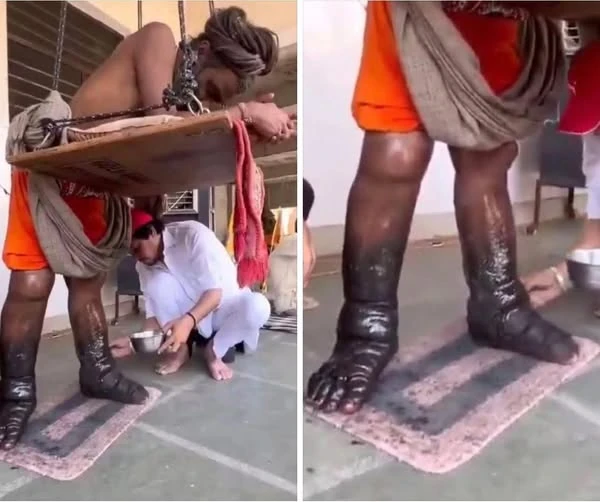
A widely shared image identifies the man leaning over a suspended wooden support as Dulal Giri Ji Maharaj, a Hindu ascetic associated with a vow to remain standing in devotion to Shiva. The image also shows a close view of lower legs that look swollen and dark. It does not show how long he has followed the vow, identify a medical condition, or tell us whether the visible changes came from standing alone. Those gaps matter as much as the startling picture.
The supplied image has two panels. In one, the man is upright with much of his upper body's weight resting on a wooden platform, while another person tends to his feet. In the other, the camera focuses on his legs. Viewers may see wounds, but the resolution is too low to determine whether any open sores are present, how deep they are, or what caused the colour and swelling. A photograph should invite careful questions, not an instant diagnosis.
What is known about the vow
The subject is identified in the circulated footage as Dulal Giri Ji Maharaj. Reports link his practice to devotion to Shiva, a major Hindu deity. Some retellings say he has stood for five years, others nearly twelve, and some imply a lifelong vow. I found no independent record that establishes the start date, documents every day of the practice, or includes a direct medical history from him. The phrase standing for his whole life would therefore be inaccurate.
The broader form of austerity has a name: khareshwari or standing tapasya. An ethnographic conference abstract by anthropologist Daniela Bevilacqua describes Indian ascetics who remain standing for years as one example of demanding vows (https://basr.ac.uk/wp-content/uploads/2018/08/basr-isasr-information-booklet-1-september-2018.pdf). The scholar notes that such practices can have several meanings for their practitioners, including discipline, religious devotion, and social purpose. That background helps explain the category of vow. It does not verify this man's personal motivation, exact duration, or medical condition.
Respect for his religious choice and concern for his body can coexist. A person may understand an action through faith, family, and community in ways that an outsider cannot measure. Medical research can study what prolonged immobility tends to do to legs. It cannot decide whether someone has reached a spiritual goal. Nor should a health article treat an individual as a spectacle simply because a video is visually striking.
What happens to blood and fluid when we stand
Gravity pulls blood and fluid toward the lower body while a person is upright. Veins in the legs need help moving blood back toward the heart. Walking and ankle movement squeeze muscles around those veins, acting as a pump. Standing still gives that pump less help. This is a general explanation of circulation, not a diagnosis of Dulal Giri Ji Maharaj.
A direct physiology study measured pressure in the leg muscles and veins of nine healthy young women (https://pubmed.ncbi.nlm.nih.gov/7966808/). Researchers recorded pressures while the participants lay down, sat, stood, moved their feet, and walked. Venous pressure was higher in upright positions, and walking produced the alternating pressure changes expected from the calf pump. The study was small and used invasive measurements, but it illustrates a useful difference: being upright and moving are not the same thing for the veins.
Even a short static-standing test can make legs feel different. In a study of 15 people with healthy veins, lower-leg volume rose by an average of 63 millilitres during 15 minutes of standing, while reported discomfort and the urge to move also increased (https://pubmed.ncbi.nlm.nih.gov/35142231/). Sixty-three millilitres is a few tablespoons of fluid spread through the lower leg, not a dramatic visible transformation. The small experiment measured an immediate response, not what would happen over years. It shows why a person may shift weight or walk after standing in one place.
A 2025 randomized crossover study tested two hours of static standing in 32 healthy participants and 12 people with chronic venous insufficiency (https://pubmed.ncbi.nlm.nih.gov/40818417/). Each person stood under different stocking conditions while researchers measured leg volume and discomfort. Compression reduced measured swelling compared with no stocking. That controlled comparison supports the idea that lower-leg fluid responds to physical pressure during a short standing period. It does not tell us what support, clothing, movement, or treatment this ascetic uses, and it is not a reason to put compression on an unexplained leg problem without assessment.
What longer-term worker studies can and cannot tell us
Short laboratory experiments explain immediate fluid changes. They cannot answer whether years of standing increase the chance of vein disease. A prospective Danish study followed employed adults for twelve years after asking about their work posture (https://pubmed.ncbi.nlm.nih.gov/16299093/). Among 5,647 employed respondents, the researchers identified 111 hospitalizations for varicose veins. Workers whose jobs involved standing or walking for at least three quarters of the workday had a pooled risk estimate about 1.78 times that of other workers after adjustment for several measured factors.
This result is an association in a working population. The study grouped standing and walking together and measured job exposure at baseline. It could not observe every hour of each participant's later life or remove every difference between occupations. Hospital treatment captures more serious cases, not everyone with leg discomfort. The study gives a reason to take years of heavy upright exposure seriously, but it cannot be applied as a numerical prediction for one ascetic with an unusual vow.
A much larger Danish worker analysis also linked mostly standing jobs with later hospitalization for varicose veins in both men and women (https://pubmed.ncbi.nlm.nih.gov/11103840/). That reinforces the general association while sharing some of the same limitations: occupational exposure is not an unbroken standing vow, and a vein diagnosis requires more than viewing a photograph. Neither study establishes that standing itself is always harmful. Ordinary standing, walking, and changing position are part of daily life. The concern is prolonged, repetitive exposure without enough opportunity to move or rest.
The distinction also helps explain why short exercise breaks are a different subject. That article discusses planned bouts of movement and their measured effects on fitness or blood sugar. The research on a standing vow deals with sustained posture, leg fluid, and possible strain. One cannot use the benefits of moving as proof that remaining upright for years is healthy.
What the dark legs in the image cannot diagnose
The photograph's lower-leg panel looks dark and enlarged. It does not show whether the changes are caused by veins, lymphatic drainage, infection, injury, skin disease, the lighting and camera, or more than one factor. It does not provide pulses, sensation, temperature, blood-flow tests, or a clinician's examination. Even a high-resolution picture would not settle those questions.
In a study of 90 patients already diagnosed with active or recently healed venous leg ulcers, swelling, skin darkening, and hardened skin were common findings (https://pubmed.ncbi.nlm.nih.gov/21413949/). That does not mean everyone with dark or swollen legs has a venous ulcer. The researchers selected people because they had that condition, then examined them and assessed their circulation. Their findings describe a patient group, not a photographic test that can diagnose the man in the viral image.
The National Health Service explains that a leg ulcer is an open sore that often needs professional assessment and may be accompanied by swelling or discoloured skin (https://www.nhs.uk/conditions/leg-ulcer/symptoms/). Its diagnostic guidance describes an in-person history, examination, and sometimes circulation tests (https://www.nhs.uk/conditions/leg-ulcer/diagnosis/). Those steps are especially important before anyone assumes a wound is venous or tries compression. The image supplied here cannot establish whether there is an ulcer at all.
Online viewers sometimes call a dark leg gangrene on sight. That is a serious claim with consequences, and this picture cannot support it. The same caution applies to naming chronic venous insufficiency, lymphedema, or infection. A clinician who can speak with and examine the person would need to decide what, if anything, requires treatment. The humane response to a concerning image is to avoid turning uncertainty into a public diagnosis.
Looking beyond the viral claim
The claim that Dulal Giri Ji Maharaj has never sat or lain down for twelve years may be central to the viral story, but a short clip cannot prove it. Support from a hanging board is visible; what happens during the rest of a day is not. The image does not reveal the vow's precise rules, whether he changes weight between legs, or how he rests. We should not fill those gaps with dramatic invented details.
The studies provide a narrower and more valuable lesson. Upright posture changes leg pressure. Static standing can increase measured leg volume within minutes. Years of mostly standing work are associated with a greater chance of serious varicose-vein disease in some populations. Those findings explain why the visible leg changes deserve concern, while leaving the man's own diagnosis and history open.
This story can be told without treating faith as a medical test or suffering as entertainment. His purpose is his to explain. If he has painful swelling, broken skin, or other symptoms, those deserve direct care and an examination rather than guesses from strangers. Readers can learn about circulation from the research while remembering that one person's body and religious life are more than a viral image.