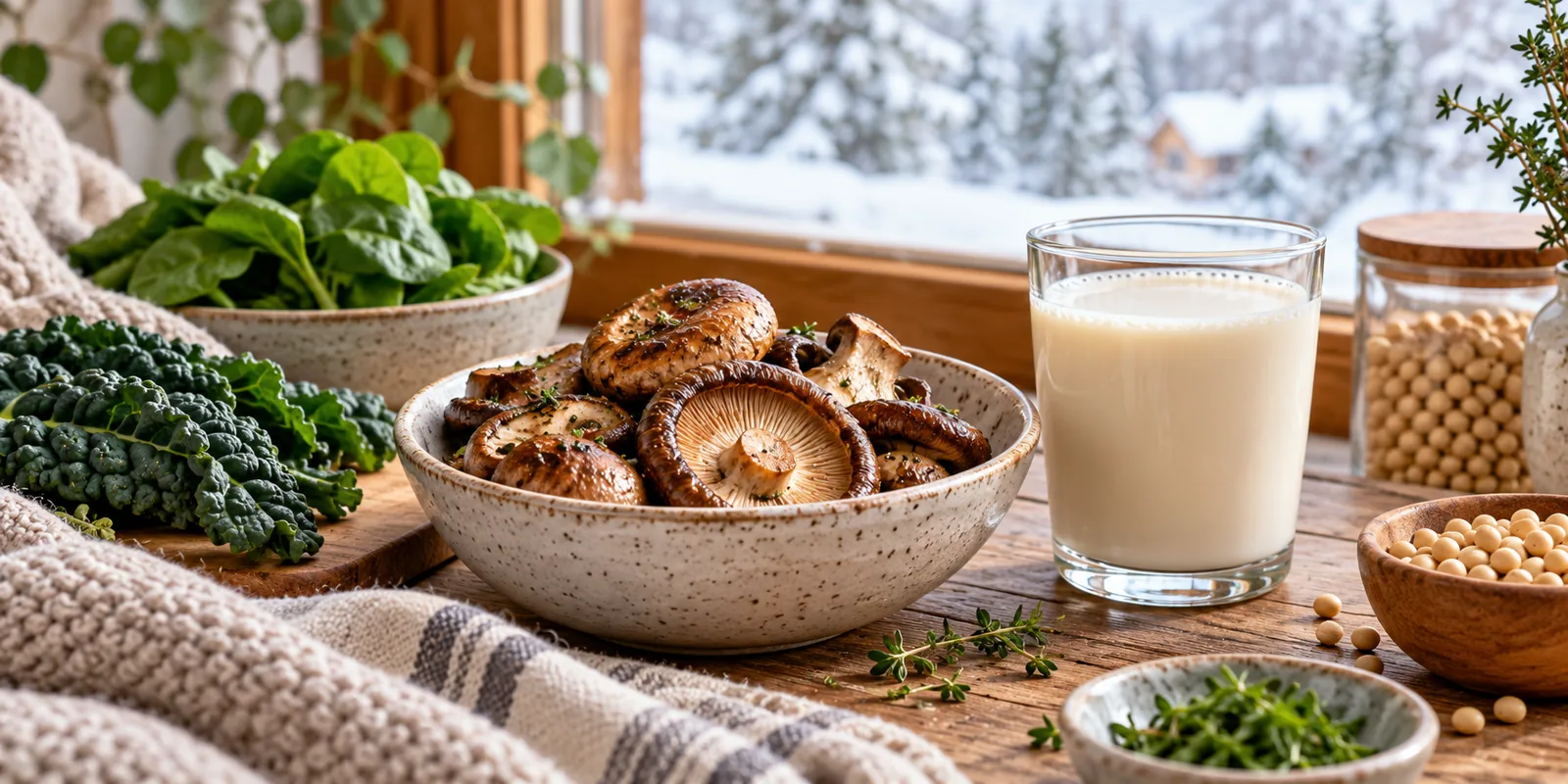
UV-exposed mushrooms can supply vitamin D, yet a recent human trial found that eating them did not stop total vitamin D status from falling through winter. Fortified plant drinks and other foods can contribute predictable amounts if the label lists vitamin D, while winter sunlight may supply very little in northern places. The answer depends on the food's actual vitamin content, the season, and a person's starting level. A bowl of ordinary mushrooms cannot be assumed to solve a low vitamin D reading.
Vitamin D helps the body absorb calcium and supports normal bone health. The body can make it when ultraviolet B light reaches skin, and it can obtain it from fortified foods or supplements. A blood test called 25-hydroxyvitamin D, shortened to 25(OH)D, is the usual measure of vitamin D status. This is a marker, not a direct count of stronger bones or fewer fractures. It gives researchers a way to compare sources over weeks or months.
Food choices deserve a clear explanation. Some mushrooms contain vitamin D2 after exposure to ultraviolet light. Plant drinks, cereals, and some juices may be fortified with D2 or D3. A product's label matters because similar-looking foods can contain very different amounts. Ordinary vegetables and most untreated mushrooms provide little vitamin D.
Why winter changes the sunlight part of the equation
The angle of the sun affects how much vitamin-D-producing ultraviolet B reaches the ground. A European analysis of measured atmospheric data across 46 capital cities (https://pubmed.ncbi.nlm.nih.gov/36501219/) found a strong seasonal pattern and large differences by location. The median gap between each city's yearly high and low vitamin-D-weighted ultraviolet B was 36-fold. That is not a blood test in 46 groups of people; it is an environmental analysis of the light available to make vitamin D.
Clouds, pollution, clothing, skin pigmentation, time outdoors, and the amount of skin exposed add further variation. A sunny-looking winter day does not guarantee useful ultraviolet B. Sitting beside a closed window is different from exposing skin directly, because ordinary window glass blocks most ultraviolet B. The time of year at one latitude cannot be converted into one safe sun-exposure rule for everyone.
A human winter experiment in two locations, including England, adds perspective. The D-SOL randomized trials (https://pubmed.ncbi.nlm.nih.gov/34255034/) assigned women to 15 micrograms of vitamin D3 or placebo each day for twelve weeks. Blood 25(OH)D rose in the supplemented groups, while the amount of measured ultraviolet B exposure did not explain the end result after other factors were considered. The participants used D3 supplements, so the trial is not direct evidence about foods. It does show why relying on winter light alone can be uncertain.
Sunlight also brings skin-cancer risk with excessive ultraviolet exposure. Chasing a particular blood number by tanning or using an unregulated ultraviolet lamp is not a sensible response to a weak winter sun. Food labels and individual clinical advice offer a more measurable path when a person is concerned about deficiency.
What makes a mushroom a vitamin D food?
Mushrooms use ultraviolet light to turn a natural compound called ergosterol into vitamin D2. Ordinary store mushrooms may have little D2, while UV-treated products can have much more. The NIH Office of Dietary Supplements fact sheet (https://ods.od.nih.gov/factsheets/Vitamind-HealthProfessional/) lists a half cup of UV-exposed white mushrooms at about 366 international units, or IU, but the amount is a food-data example, not a guarantee for every brand. The label or supplier information is more useful than the word mushrooms alone.
An early winter trial of mushroom soup (https://pubmed.ncbi.nlm.nih.gov/21540874/) studied 26 young adults whose initial 25(OH)D was at or below 50 nmol/L. Researchers randomly assigned them to UV-treated mushroom soup, a D2 supplement, or placebo for five weeks. The mushroom soup supplied a measured large weekly amount of D2. Blood 25(OH)D increased in the mushroom and supplement groups compared with placebo. That shows the D2 made in treated mushrooms can be absorbed and affect a blood marker.
The trial does not tell a shopper what an ordinary serving of untested mushrooms will do. The soup was prepared under a controlled ultraviolet treatment and contained a high measured dose. It did not measure fractures or other long-term health outcomes. Its small groups also leave uncertainty about how the effect differs by age, body size, and starting level.
The 2026 winter mushroom trial offers a caution
The Comboni winter trial (https://pubmed.ncbi.nlm.nih.gov/42121515/) randomized 41 adults with overweight or class I obesity. For six weeks in late fall and winter, one group was asked to eat two daily servings of fresh mushrooms, each meant to provide 400 IU of D2 after ultraviolet treatment. The comparison group ate a small breadcrumb portion while participants otherwise continued their usual diets. Researchers measured both the D2-related and D3-related parts of blood 25(OH)D and also checked the mushrooms' vitamin content week by week.
Blood 25(OH)D2 rose in the mushroom group, but 25(OH)D3 fell. Total 25(OH)D declined to a similar extent in both groups. In plain language, the mushrooms affected one component of the blood test without preventing the overall winter decline. Only 67% of mushroom samples contained the intended D2, which is a serious practical finding. A food cannot reliably meet a nutrient goal if its content varies unexpectedly.
The result does not mean UV-treated mushrooms are useless. It shows that this amount, product consistency, and six-week schedule did not preserve total status in these 41 participants. The trial also cannot tell whether a different fortified food, a longer period, or a person with a different starting level would respond the same way. The work received support from the Mushroom Council, which readers should know when weighing it alongside independent replication.
The two mushroom trials are not interchangeable. One used a high, measured dose in a prepared soup for young adults with low starting status. The newer trial used fresh servings during a real winter period in an older, heavier group and discovered variable D2 content. The apparent disagreement is useful: it shows why a mechanism and one positive trial do not settle the question of a reliable daily food strategy.
Where fortified foods fit
Fortification adds a stated amount of vitamin D to a food. In the United States, some soy, oat, and almond drinks contain roughly 100 to 144 IU per cup according to the NIH food table (https://ods.od.nih.gov/factsheets/Vitamind-HealthProfessional/). Some cereals and juices also contain vitamin D. There is no promise that every brand does, and the form may be D2 or D3. Vitamin D3 is often made from lanolin, which comes from sheep wool; lichen-derived D3 is also available. D2 is usually made by exposing yeast or other fungi to ultraviolet light. Check the amount and ingredient source on the label if that distinction matters to you.
For vegan readers, the words vitamin D on a label do not establish its source. A food or supplement marked D3 may contain D3 made from sheep-wool lanolin. Look for documented lichen-derived D3 or fungal-derived D2. If a label gives only vitamin D3, ask the manufacturer where it comes from. For supplements, check the capsule and other ingredients as well. A plant-based drink does not by itself prove that its added vitamin D is animal-free.
The label can make planning concrete. A person could compare the number of cups or servings they usually have with the listed daily value. They should not multiply a serving into an extreme intake to reach a blood target that someone on the internet suggested. The NIH consumer fact sheet (https://ods.od.nih.gov/factsheets/VitaminD-Consumer/) gives age-specific recommended amounts and upper limits. For most adults aged 19 to 70, the recommended dietary allowance is 600 IU per day, and the general upper limit is 4,000 IU per day from all sources. Individual medical needs can differ.
A trial of fortified orange juice offers more direct evidence for a plant-based food vehicle. Researchers randomly assigned adults aged 18 to 84 to receive vitamin D2, vitamin D3, or a placebo in orange juice or capsules for 11 weeks at the end of winter (https://pubmed.ncbi.nlm.nih.gov/20427729/). Each active group received 1,000 IU per day. Blood vitamin D status rose in the vitamin D groups, and the researchers found no meaningful difference between the orange juice and capsule delivery methods. The study tested a measured, fortified drink, not ordinary juice. It tracked a blood marker rather than fractures or long-term health. Its D2 arm is especially relevant for readers choosing an animal-free form of vitamin D, although the paper did not verify the commercial origin of every ingredient.
When a food-first plan needs a closer look
Someone with known deficiency, osteoporosis, a malabsorption condition, kidney disease, or a medicine that affects vitamin D metabolism may need individual testing and guidance. The same applies when a person eats few fortified foods and has little winter sun. A clinician can interpret a blood result with the person's history instead of applying a target number to everyone.
More is not automatically better. Very high vitamin D intake, usually from supplements, can cause too much calcium in the blood and serious harm. The NIH consumer guidance (https://ods.od.nih.gov/factsheets/VitaminD-Consumer/) explains symptoms and upper limits. Several products can each contain vitamin D, so adding their labels matters. Ordinary food portions are less likely to cause excess, but guessing at a supplement amount is avoidable.
A practical approach is to know the season, read fortification labels, and treat UV-exposed mushrooms as one possible contributor with variable content. The blood test tells whether a particular person has enough, while the trials tell us how uncertain any single food can be. A winter routine built from foods you enjoy and can check on a label is easier to evaluate than a claim that one mushroom meal or one sunny walk will solve vitamin D for everyone.