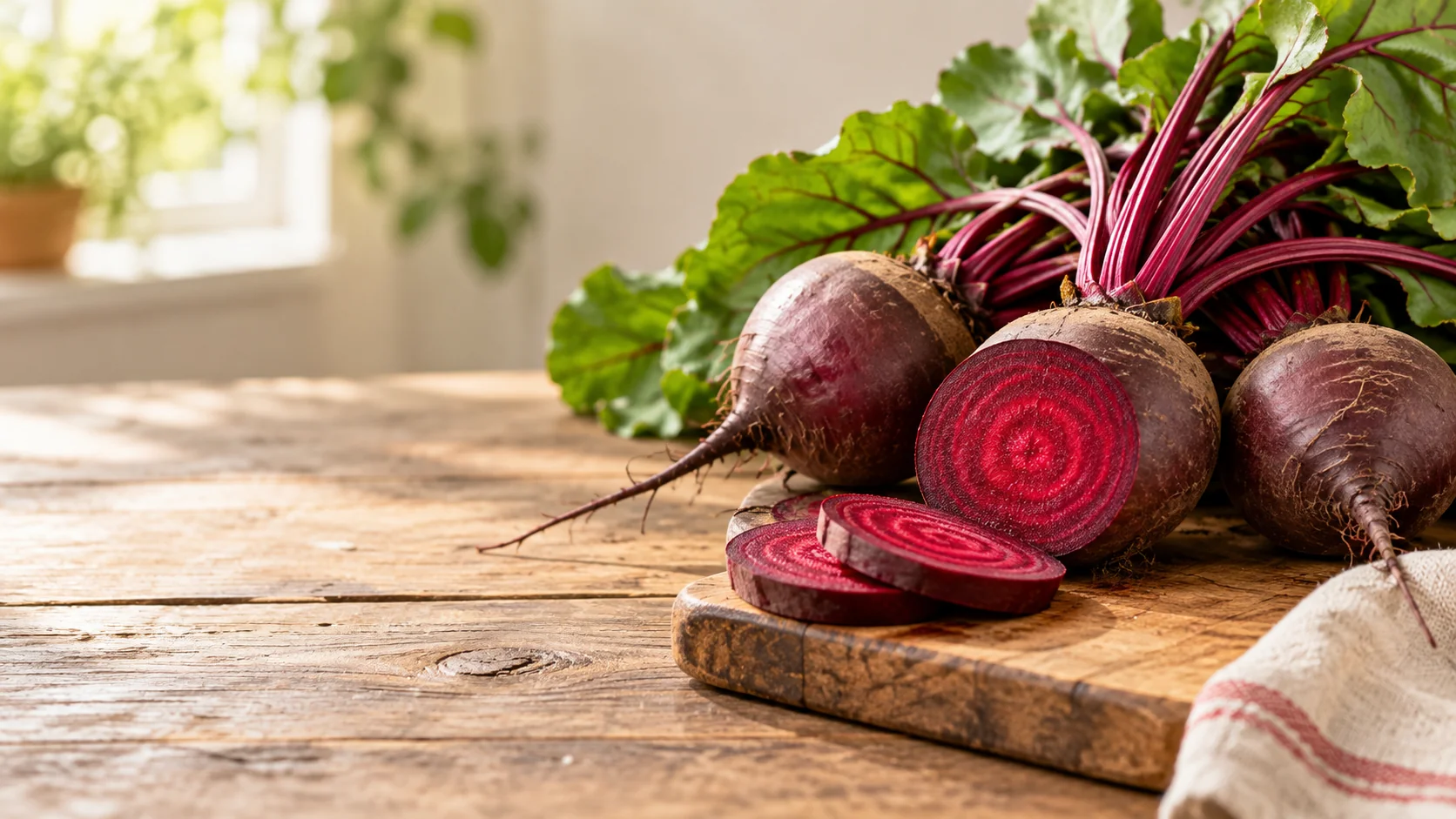
In a small human study, beetroot powder changed some short-term measures of blood-vessel function. Beets contain nitrate, which your body can turn into nitric oxide, a chemical signal that helps blood vessels relax. The study did not test whether beetroot prevents heart disease.
A 2026 study published in Food & Function (https://doi.org/10.1039/D5FO05298J) tested this question in people. Its findings are interesting, but more limited than a promise of better heart health.
What did the researchers do?
The study included 17 healthy young men. Each man tried several conditions on different days: beetroot powder containing 200, 400, or 800 milligrams of nitrate, and a comparison condition without beetroot powder. Using the same people for each condition helps reduce differences caused by one person naturally having more flexible arteries than another.
The researchers measured blood pressure and how blood vessels responded over the hours after a single serving. One measurement, called flow-mediated dilation, looks at how much an artery in the arm widens after blood flow increases. In plain language, it is a short-term test of how readily that blood vessel opens up. They also measured signs of stiffness in larger arteries.
These are useful clues about how the circulation system is working at that moment. They are not the same as measuring whether someone later has a heart attack or stroke.
What changed?
After the 400-milligram nitrate serving, the arm artery widened more on the flow test than it did in the comparison condition. The researchers reported an improvement of about three percentage points. The 200- and 800-milligram servings did not show that same result on this particular test.
Some measures related to artery stiffness improved after the beetroot servings, but the pattern differed depending on the measurement. The highest serving, 800 milligrams of nitrate, lowered a measure of pressure in the large artery near the heart by about 4 mmHg compared with the comparison condition. The study did not find a meaningful improvement in the ordinary blood-pressure reading taken at the arm.
Different measurements responded to different amounts, and several did not improve. The study did not show that larger servings work better or that beetroot lowers everyone's blood pressure.
What can this tell an everyday reader?
The result supports a modest idea: in this small group of healthy young men, one serving of nitrate-rich beetroot powder caused some short-term changes in blood-vessel measurements. It gives researchers a reason to study the question further.
It cannot tell us whether eating beets regularly prevents heart disease, whether the effect lasts, or whether the same results apply to women, older adults, or people with high blood pressure. Beetroot powder with a measured nitrate amount is also not identical to an unspecified serving of cooked beets or juice. The researchers themselves called for longer-term studies.
For now, beets can simply be one of many vegetables in a varied diet. This study is interesting evidence about how the body responds for a few hours, not a reason to replace prescribed care or chase a particular supplement dose.
Why might beetroot affect blood vessels?
Nitrate is found naturally in beetroot and many other vegetables. After you eat it, bacteria in your mouth help turn some of it into nitrite. Your body can then make nitric oxide from nitrite. Nitric oxide is a signal that helps the muscles around blood vessels relax. In simple terms, the vessel may widen and allow blood to move with less resistance.
That pathway gives researchers a sensible reason to study beetroot. It does not guarantee that every person will respond in the same way. The bacteria in people's mouths differ. So do their diets, medicines, ages, and existing health conditions. Even two beet products may contain quite different amounts of nitrate. The 2026 trial used powder with measured amounts, which made a fair experiment possible. A serving of roasted beets at home is not a precisely measured dose.
The pathway also helps explain why the trial focused on the hours after one serving. Nitrate and its related compounds change in the body over time. Researchers wanted to see whether those changes lined up with a short-term response in the arteries. That is a useful first question, but it leaves the longer-term question open.
Why the study design matters
The 17 men each tried every study condition on separate visits. Researchers call this a crossover design. It gives the team a way to compare a participant's response to beetroot with that same participant's response on a comparison day. That reduces the influence of differences between people. Someone whose arteries naturally widen more than another person's does not automatically tilt one entire treatment group.
But crossover design does not solve every problem. Day-to-day measurements can still vary. A result seen in 17 healthy young men may look different in a larger, more varied group. The participants were not followed for months or years, so the experiment cannot show whether any change lasts. It also cannot tell us how women, older people, or people taking blood-pressure medicine would respond.
The study looked at several outcomes. One was flow-mediated dilation, the mouthful of a term used for an arm-artery test. The researchers briefly changed blood flow, then measured how much the artery opened. Another group of outcomes described artery stiffness. Still another assessed pressure in the aorta, the large artery carrying blood away from the heart. These are related parts of circulation, but they are not interchangeable. A study can find a change in one test and no change in another without being internally contradictory.
What does a better test result mean?
A blood-vessel test is a marker. A marker is a measurable clue that might be related to future health. It is not the future event itself. If an artery widens more readily for a few hours, researchers may want to know whether this could matter over time. The test alone cannot answer whether a person will have fewer heart attacks or strokes.
Imagine testing a new habit on a car and finding that its engine runs a little cooler for one drive. That would be interesting. It would not prove the car will need fewer repairs over five years. A short-term blood-vessel measurement deserves the same careful reading.
The pattern of results also matters. In this trial, the middle nitrate amount improved the arm-artery widening test, while the highest amount did not show that same clear change. The highest amount did affect a pressure measure near the heart. The usual upper-arm blood-pressure reading did not significantly improve. If we report only the improved measurements, we give a distorted impression that every part of circulation benefited.
The lack of a simple dose pattern is another reason to avoid claiming an ideal serving size. The body does not always respond in a straight line where twice as much produces twice the effect. This study was designed to explore the question, not to produce a shopping guide for beetroot powders.
A second study tested daily juice for longer
A different controlled human study (https://pmc.ncbi.nlm.nih.gov/articles/PMC11034575/) provides an important counterpoint. It involved 15 middle-aged and older adults who already had high blood pressure. They tried nitrate-rich beetroot juice and a comparison juice containing very little nitrate. The researchers measured the response after the first serving and after four weeks of daily juice.
The nitrate-rich juice did what the researchers expected in one respect: it raised nitrate-related substances in blood and saliva. Some clinic blood-pressure readings were lower a few hours after the first serving. But after four weeks, the study did not find a sustained difference in its main blood-flow measure or in home and around-the-clock blood-pressure readings compared with the other juice.
That result does not cancel the 2026 powder trial. The two studies looked at different people, different products, different time spans, and different tests. It does show why a few-hour improvement should not be turned into a promise of lasting benefit. Even when the body absorbs a substance and a short-term reading shifts, the longer-term outcome may be less clear.
The second study is small too. It cannot settle the entire question of beetroot and blood pressure. It does remind us to ask whether a result appears repeatedly, especially in the people who might most want a treatment. Healthy young volunteers and older adults with high blood pressure are not the same population.
Can we translate the trial into an everyday serving?
Not reliably. The researchers measured nitrate in a powder. The amount of nitrate in beets from a shop may vary with growing conditions, storage, and preparation. A beet juice shot may differ from both the powder and a cooked vegetable. Other compounds in beetroot may also affect the response. A claim that everyone should drink a particular number of milliliters of juice would need research on that exact product and amount.
That is why the figures in the trial are best understood as study conditions. The 200-, 400-, and 800-milligram amounts let scientists explore a possible dose response. They are not established personal targets. The participants were screened healthy young men in a controlled setting, not a cross-section of people buying supplements.
If you take medication for blood pressure or have a heart condition, do not replace treatment with beetroot based on these findings. Food choices are worth discussing as part of overall care, but a small supplement experiment cannot tell you how to change medicine safely. A concentrated product is also a different choice from enjoying beets as part of a meal.
The most useful takeaway
Beetroot is a vegetable with an interesting biological pathway. The 2026 trial (https://doi.org/10.1039/D5FO05298J) shows that a single serving of nitrate-rich powder can change some short-term blood-vessel measurements in healthy young men. It also shows that the results vary by test and by amount. The familiar arm blood-pressure reading did not significantly improve.
The four-week juice trial (https://pmc.ncbi.nlm.nih.gov/articles/PMC11034575/) shows that a short-term signal may not last or appear in the same way in older adults with high blood pressure. The honest conclusion is that the research is promising enough to keep studying, but too limited to prove that beetroot supplements prevent heart disease.
You can enjoy beetroot without turning dinner into a medical experiment. When you see a strong claim about any food, ask who took part in the study, what they actually consumed, how long they were followed, and whether researchers measured a temporary marker or a real health outcome. Those questions make the evidence much easier to understand.