Baduanjin lowered average 24-hour systolic blood pressure by about 3 mm Hg more than self-directed exercise in a 2026 randomized trial. That difference appeared after 12 weeks and remained at one year. The practice also performed similarly to brisk walking in the trial, although a nonsignificant difference cannot prove the two are equal. For someone who enjoys slow, structured movement, this is useful evidence that the practice can be a reasonable way to work on blood pressure.
The BLESS trial (https://pubmed.ncbi.nlm.nih.gov/41706075/) is unusually helpful because it measured blood pressure throughout a full day, followed people for 52 weeks, and included both a general exercise comparison and a walking group. Its result is modest, and it applies most directly to adults with blood pressure near the lower end of the hypertension range. The trial did not test whether baduanjin prevented heart attacks or strokes.
What is baduanjin?
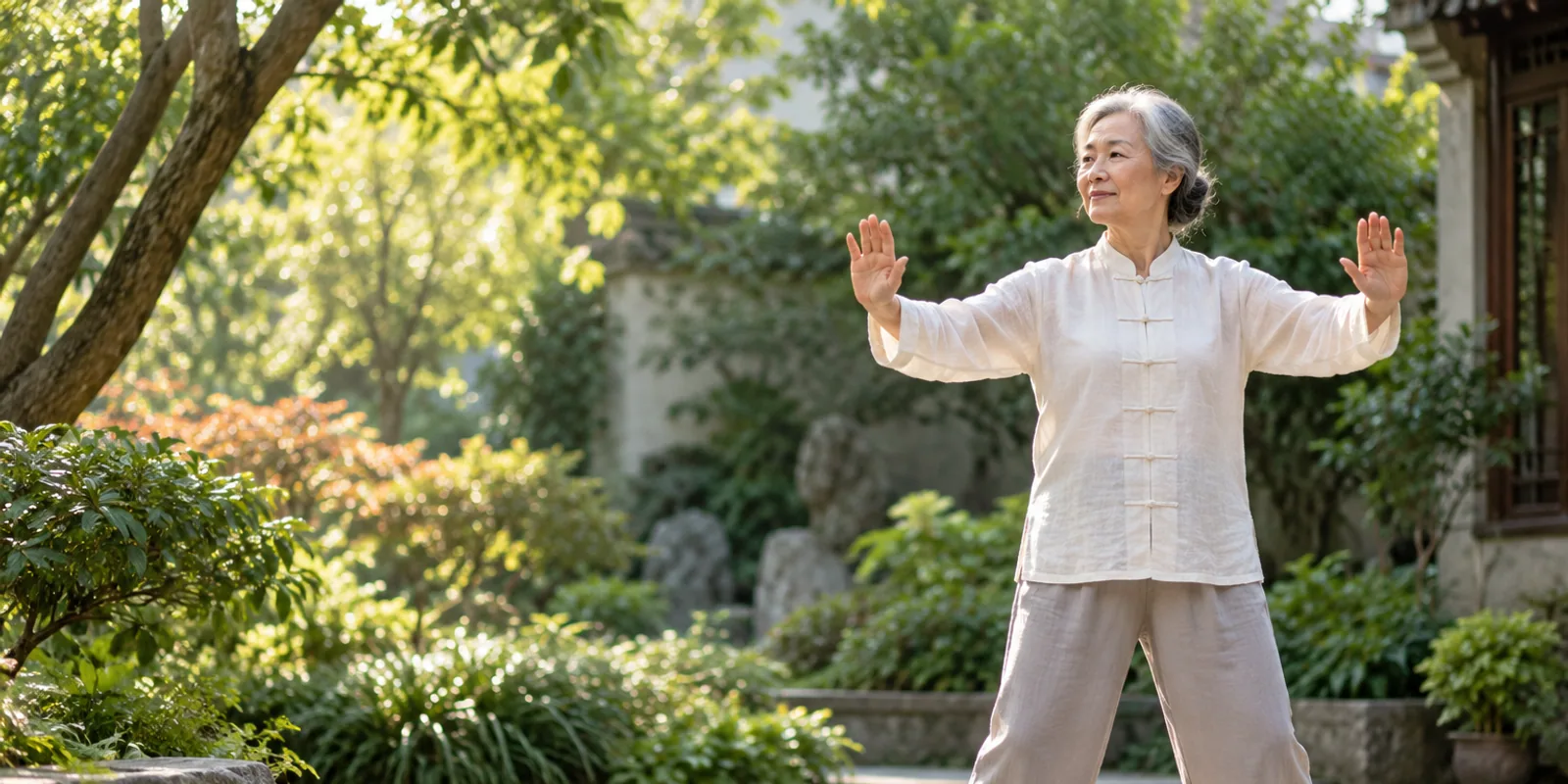
Baduanjin, sometimes called the Eight Brocades, is a sequence of eight gentle standing movements. It belongs to the broader family of qigong practices, which combine movement, posture, breathing, and focused attention. Movements typically involve lifting or extending the arms, turning the body, and shifting weight without the speed of an aerobic workout. The sequence can be taught in a group and then practiced at home. Our introduction to qigong explains the broader practice, but the blood pressure figures here come from the clinical trial.
The exercise is accessible in the sense that it needs little equipment. Accessible does not mean effortless for every person. Standing balance, shoulder motion, and a comfortable pace still matter. A person with dizziness, recent injury, or a condition that limits movement may need a modified routine or an instructor who can adapt the poses.
Who joined the yearlong study?
Researchers enrolled 216 adults from seven communities in China. Participants were at least 40 years old, and their qualifying blood pressure was in a narrow band: systolic pressure of 130 to 139 mm Hg and/or diastolic pressure of 85 to 89 mm Hg. Systolic is the top number on a blood pressure reading. The mean age was 57.3 years, and nearly two-thirds of participants were women. The BLESS trial record (https://pubmed.ncbi.nlm.nih.gov/41706075/) describes a multicenter, randomized study, meaning the comparison was made across several communities and group assignment was determined by chance.
The researchers assigned 108 people to baduanjin, 54 to self-directed exercise alone, and 54 to brisk walking. The uneven numbers were intentional. The intervention continued for 52 weeks. People knew which activity they were doing, as they would in almost any exercise study, while outcome assessment was blinded. That combination makes the blood pressure measurement more persuasive than an unblinded report of how healthy participants felt.
These participants were not a sample of everyone with hypertension. Their readings sat in a specific range, and they were recruited in Chinese communities where baduanjin is culturally familiar. The result may differ in people with substantially higher pressure, frailty, pregnancy, or medical conditions that affect exercise. The paper does not establish a safe or effective dose for every reader.
What did the researchers measure?
The two main outcomes were changes in average systolic pressure over 24 hours at week 12 and week 52. A wearable monitor takes repeated readings as someone goes through daytime activities and sleep. This reduces the chance that a single reading in a clinic will dominate the result. Blood pressure still varies from day to day, so a group average is more informative than any one person's change.
The trial tested its comparisons in a set order. It first asked whether baduanjin beat self-directed exercise at 12 weeks, then at 52 weeks. Only after those tests did it assess whether baduanjin beat brisk walking at one year. This ordering, reported in the BLESS paper (https://pubmed.ncbi.nlm.nih.gov/41706075/), matters because testing many outcomes without a plan can produce chance findings. The reported primary outcome was a measured risk marker. It was not a count of strokes, heart attacks, medication changes, or deaths.
The publication calls the participants' range high-normal blood pressure. Classification differs by country and guideline. Under the American Heart Association's current categories, a systolic reading of 130 to 139 mm Hg falls in stage 1 hypertension (https://professional.heart.org/en/science-news/2025-high-blood-pressure-guideline/top-things-to-know). Readers should use their own clinician's interpretation of repeated readings rather than assume that a label from a Chinese trial maps exactly onto their situation.
How much did blood pressure change?
At 12 weeks, the baduanjin group's average 24-hour systolic pressure had fallen 3.1 mm Hg more than the self-directed exercise group's, after adjustment in the trial analysis. The 95% confidence interval for that difference ran from a 5.9 mm Hg greater reduction to a 0.2 mm Hg greater reduction. At one year, the difference was 3.3 mm Hg in favor of baduanjin, with a confidence interval from 6.3 to 0.3 mm Hg. Both intervals narrowly excluded no difference. These are the trial's between-group results (https://pubmed.ncbi.nlm.nih.gov/41706075/), not the total amount by which an individual should expect a home reading to fall.
The brisk walking comparison is easy to overstate. At 52 weeks, the estimated difference between baduanjin and walking was 0.7 mm Hg in favor of baduanjin, but the confidence interval stretched from 3.9 mm Hg in favor of baduanjin to 2.6 mm Hg in favor of walking. The statistical test found no clear winner. That supports saying the two groups had similar results in this sample. It does not show that one routine can replace all the physical benefits of walking, or that the two would stay equivalent in a much larger trial.
The researchers reported no significant difference in adverse events among the three groups. This is reassuring within the study, but 216 participants are too few to rule out uncommon problems. The PubMed abstract does not provide a detailed breakdown of events or adherence. Full text access was restricted during this review, so those details need checking before publication.
Why does a few points matter, and what remains unknown?
A small shift in average blood pressure may be worthwhile across a population. For one person, however, a 3 mm Hg group difference can be hard to distinguish from normal day-to-day variation without repeated, careful measurement. The trial shows an effect on a cardiovascular risk marker. It cannot tell us how many participants avoided a future stroke or whether any person could safely stop medicine. Those outcomes require different studies and longer follow-up.
The design has several strengths. Random assignment reduces the chance that baseline differences explain the result. Seven recruitment communities make the finding less dependent on one instructor or clinic. A 24-hour monitor offers a better look at daily pressure than an isolated office reading. A one-year follow-up addresses the common problem of short exercise trials that show an early change and then stop.
There are limits too. Neither participants nor instructors could be blinded to a movement practice, and expectations can change how consistently people exercise or follow other habits. The self-directed exercise group may not have received the same attention or structure as the baduanjin group. The study therefore tests a complete practice and delivery approach, not a special property of eight movements isolated from instruction, routine, and motivation. The publication's abstract reports no individual adherence figures, so we cannot tell from that record how much practice was needed for the observed average result.
It is also possible that different people respond differently. An average difference does not mean every participant's pressure fell. The paper reports no clear variation across the subgroups it tested, but subgroup analyses can miss real differences when each group is small. A person who dislikes the routine or cannot do it regularly might gain less than someone who finds it pleasant and sustainable.
Does earlier research point the same way?
An earlier randomized trial in 170 older community adults at risk of ischemic stroke tested supervised baduanjin for 12 weeks against keeping usual habits. The Zheng trial (https://pubmed.ncbi.nlm.nih.gov/30718622/) found lower systolic and diastolic pressure in the baduanjin group, alongside changes in several other measured outcomes. Participants did five 60-minute sessions each week, a much larger time commitment than a brief home routine. Because the trial measured many outcomes and used a usual-habits comparison, it should support the direction of the BLESS result without supplying a single universal estimate of benefit.
Research on related movement practices offers context, but the practices should not be treated as identical. A 2024 trial of 342 adults with elevated pressure compared tai chi with aerobic exercise for 12 months. The Li trial (https://pubmed.ncbi.nlm.nih.gov/38335001/) found a 2.4 mm Hg greater fall in office systolic pressure with tai chi. Both groups attended four supervised one-hour sessions each week. Tai chi has different forms and instruction from baduanjin, and the study measured office pressure as its main outcome. The shared lesson is narrower than a claim that any slow movement will lower blood pressure: structured, repeated mind-body exercise deserves serious study alongside other forms of physical activity.
The BLESS paper does not establish that baduanjin lowers pressure through a particular breathing or stress pathway. Movement itself, regular practice, relaxation, social support, or a mix of these could contribute. Mechanism claims need direct testing, not an attractive explanation added after the result.
What can a reader do with this evidence?
Baduanjin is worth considering if you have mildly raised blood pressure and prefer a gentle, repeatable practice. A class or qualified instructor can help you learn the sequence, find a pace that feels steady, and adapt movements that strain a joint. Start within your present ability. The trial tested a sustained program, so one short session should not be expected to move a blood pressure reading. The Healthy Mango article on a small Monday blood pressure study is a reminder that a single reading can mislead; it is background on measurement, not evidence for baduanjin.
Use a validated upper-arm monitor if you follow blood pressure at home. The American Heart Association's measurement instructions (https://www.heart.org/en/health-topics/high-blood-pressure/understanding-blood-pressure-readings/monitoring-your-blood-pressure-at-home) advise sitting quietly, supporting the arm at heart level, and taking two readings one minute apart each time. Record readings across days and review the pattern with a clinician. That is more useful than checking immediately after a session and crediting the practice for one low number.
Qigong is generally considered a safe form of activity when performed appropriately, but sore muscles, dizziness, and balance problems can still matter. The National Center for Complementary and Integrative Health overview (https://www.nccih.nih.gov/health/qigong-what-you-need-to-know) notes that people with health conditions may need to modify physical practices. If exercise causes chest pain, faintness, severe breathlessness, or a new neurological symptom, stop and seek medical assessment. People taking blood pressure medicine should keep taking it as directed unless their clinician changes the plan after reviewing reliable measurements.
The practical reading of the 2026 result is straightforward: baduanjin produced a small, sustained improvement in 24-hour systolic pressure against self-directed exercise in adults with a specific blood pressure range. It offers another way to move regularly for people who will actually enjoy and continue it. The trial leaves room for choice between this practice and walking, and it leaves open whether the blood pressure change translates into fewer cardiovascular events.