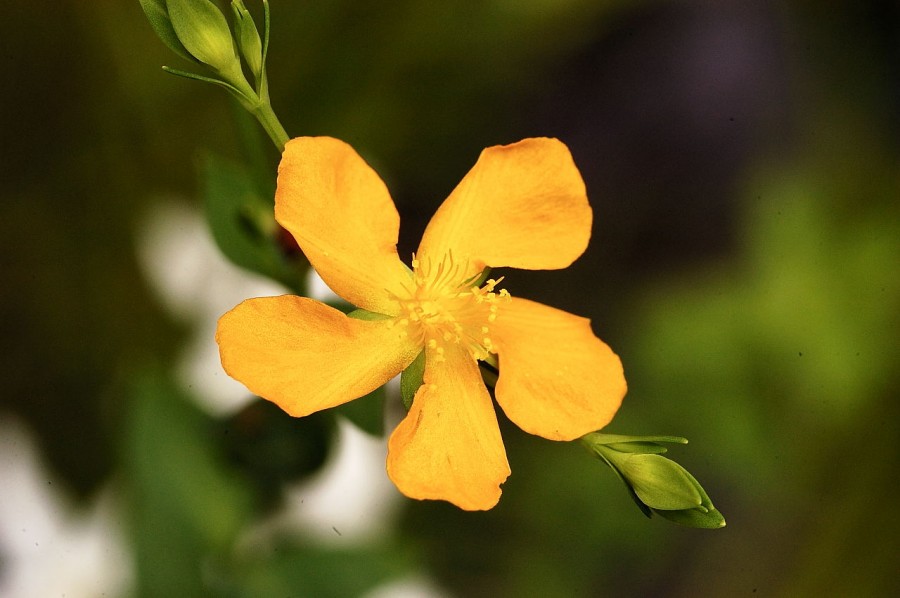
St. John's Wort may well be one of the most effective natural cures for depression -- without the side effects associated with prescription drugs. In fact, fifty percent of depressive disorders in Germany are treated (by prescription) with St. John's Wort. Despite sounding like "wart", this yellow-flowered wild plant takes its name from the Old English word for plant: "Wort", and from St. John the Baptist whose birthday was in the flowery month of June. Hippocrates even prescribed this plant as a medication back in the third century B.C.
So does it really work?
St. John's Wort is more commonly prescribed for depression in Europe than antidepressants such as Prozac. It's available over the counter in North America and the U.K. In fact, it has been used for centuries to treat both mental disorders and nerve pain.
The benefits of St. John's Wort for mild to moderately depressed people, as well as those who experience seasonal affective disorder, have been discussed in numerous medical reports and studies. As a result, this herb has a stronger medical reputation in the U.S. and Canada than other lesser-known supplements. Unlike medications, supplements are assumed by the FDA to be safe unless something shows otherwise. St. John's Wort falls into the category of a generally safe alternative to prescription antidepressants.
The National Center for Complementary and Alternative Medicine at the National Institutes of Health notes that St. John's Wort can be an effective treatment for mild and moderate depression and/or anxiety, but does not recommend its use for more serious forms of these conditions.
The American Academy of Family Physicians states that St. John's Wort may work as a weak antidepressant in comparison with a placebo, it "should not be used as a replacement for proven agents patients with major depression." Thus, if you are someone with mild cases of "the blues", St. John's Wort may be an effective approach and worth trying.
Doctors do not recommend St. John's Wort for people already taking anti-depressants or anti-anxiety medications. Its interaction with these drugs, which increase the absorption of serotonin in the brain, can cause serotonin overload. While sometimes used for weight loss, this use doesn't have strong supporting evidence.
Also, the FDA issued a statement that indinavir, a protease inhibitor used to treat HIV, has a significant negative interaction with the herb. If you are taking any medications or other nutritional supplements, please discuss these combinations with your doctor if you also choose to take St. John's Wort. Do not take this if you are pregnant or taking birth control pills.
More reasonably priced and a more 'natural' substance than antidepressants, St. John's Wort is widely attractive as a remedy for depression. It is also sold over the counter. This herb is sold in capsules, teas, and concentrated extracts. The main rule of thumb with this herb is to monitor your reaction carefully and only use St. John's Wort if you experience mild forms of mood problems such as depression and anxiety. Anyone with these issues should speak with a doctor for guidance. Also, remember that antidepressants generally take six to eight weeks to demonstrate real change.
What clinical studies found
The most encouraging evidence concerns standardized St. John’s wort extracts for mild-to-moderate depression. A 2016 systematic review of 35 studies involving 6,993 participants found that St. John’s wort performed better than placebo and was not significantly different from standard antidepressants, although the studies varied in quality and design. Read the systematic review on PubMed.
Several randomized trials of standardized extracts have also reported benefit. In a 375-person randomized trial, the standardized WS 5570 extract helped adults with mild-to-moderate major depression more than placebo. These results apply to studied preparations and cannot automatically be transferred to every supplement sold online or in shops.
The older version of this article described St. John’s wort as a natural cure and implied that it was safer than antidepressants. That wording is too strong. Results are mixed, and evidence is less certain for severe or persistent depression. The herb is not established as a universal treatment.
Safety and medicine interactions
St. John’s wort is not a harmless substitute for medical care. The herb can speed up drug-metabolism pathways and reduce the levels of important medicines, including some birth-control pills, transplant medicines, HIV medicines, cancer medicines, warfarin, digoxin, and certain statins. Combining it with antidepressants or other serotonin-affecting medicines can cause serious serotonin-related effects.
The National Center for Complementary and Integrative Health safety summary says the evidence is most suggestive for mild or moderate depression, remains uncertain for severe depression and longer-term treatment, and does not support treating the herb as a proven cure. It also lists possible side effects such as digestive symptoms, dizziness, insomnia, restlessness, and increased sensitivity to sunlight.
Do not start, stop, or combine St. John’s wort with a prescription medicine without speaking with a clinician or pharmacist. Anyone with severe depression, suicidal thoughts, bipolar disorder, pregnancy, or a complex medication list needs professional guidance rather than self-treatment. If you may be in immediate danger, contact local emergency services or a crisis service.
Bottom line
St. John’s wort may help some people with mild-to-moderate depression when a consistent, studied extract is used, but the research is not uniform and it is not established as a cure. The herb’s many drug interactions and the limits of the evidence make a blanket recommendation unsafe.