BPC-157 Arginate vs Injectable BPC-157: Which Is Better?

BPC-157 has become one of the most discussed experimental peptides in the recovery and regenerative-medicine communities. It is promoted for everything from tendon and ligament recovery to gastrointestinal protection and wound healing.
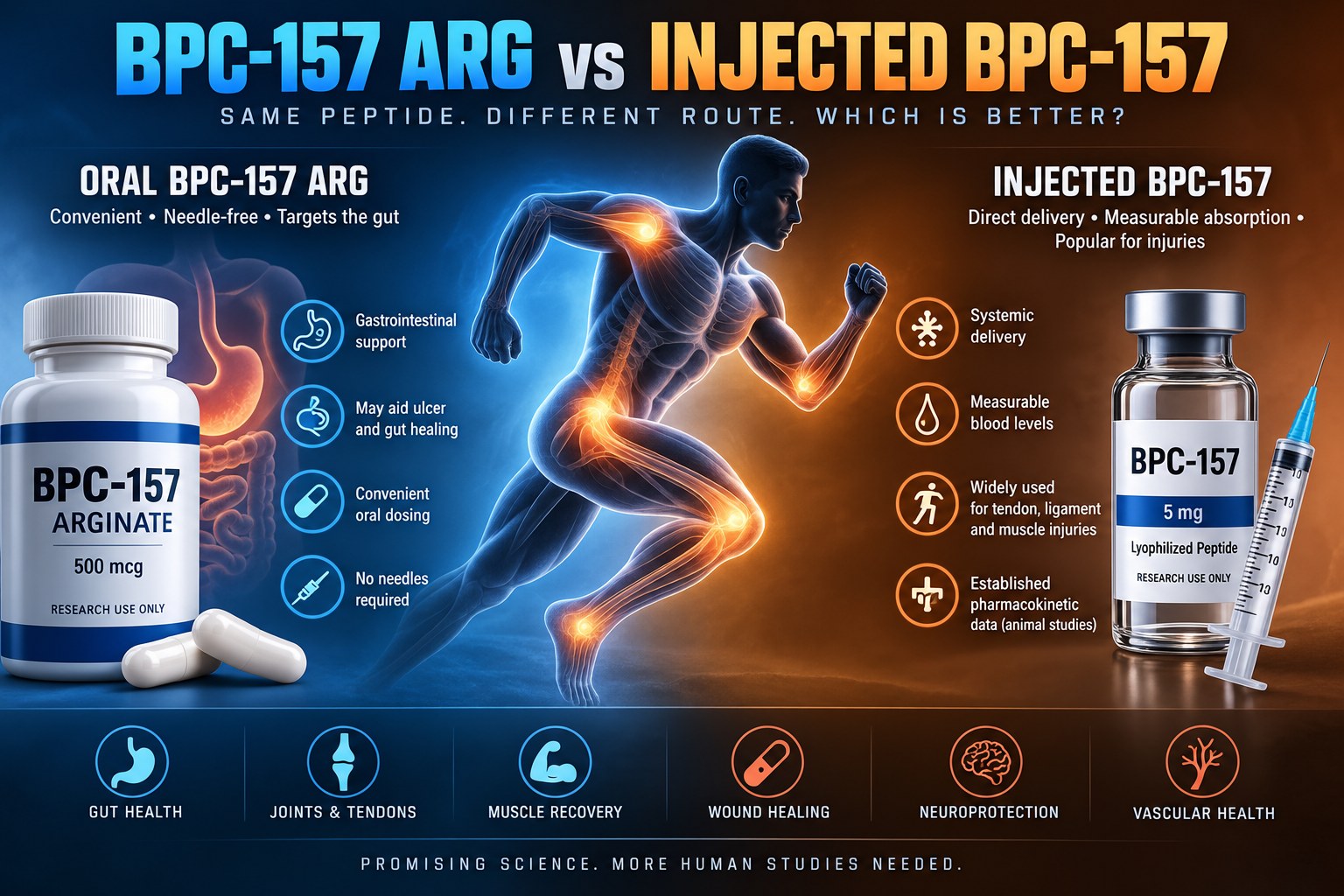
Two forms receive particularly strong attention: oral BPC-157, especially BPC-157 arginate (BPC-157 ARG), and injectable BPC-157.
This raises an obvious question: Which one is actually better?
The answer is more complicated than much of the marketing surrounding BPC-157 suggests. Animal research on BPC-157 is extensive compared with the tiny amount of human research available, but there are currently no high-quality human clinical trials directly comparing oral BPC-157 arginate with injected BPC-157.
Understanding what the research actually demonstrates is therefore essential.
What Is BPC-157?
BPC-157, or Body Protection Compound-157, is a synthetic 15-amino-acid peptide with the sequence:
GEPPPGKPADDAGLV
It is based on a peptide sequence associated with gastric proteins and has attracted research interest because of its unusual stability and the wide variety of biological effects reported in experimental models.
Animal and laboratory studies have investigated BPC-157 in connection with:
- tendon and ligament healing
- skeletal muscle injury
- gastrointestinal injury and ulcers
- wound healing
- blood-vessel formation
- nitric-oxide signaling
- inflammation
- nerve injury
These findings have generated considerable interest in BPC-157 as a potential regenerative compound.
The problem is that impressive animal results do not automatically translate into effective treatments for humans.
Recent scientific reviews emphasize this distinction. A 2025 review of BPC-157 for musculoskeletal healing found substantial preclinical evidence but extremely limited human evidence. Only a handful of small human investigations have been reported, and large randomized controlled trials are still missing.
Therefore, BPC-157 should currently be regarded as an investigational peptide rather than an established medical therapy.
What Is BPC-157 Arginate?
BPC-157 arginate is essentially BPC-157 formulated as an arginine salt.
This distinction is important because some advertisements make BPC-157 arginate sound like an entirely different peptide. It isn’t.
The underlying BPC-157 peptide sequence remains the same. The salt formulation is intended primarily to improve properties such as stability, solubility and formulation characteristics.
This becomes particularly interesting for oral administration.
Most peptide drugs are poor candidates for conventional capsules because the gastrointestinal tract presents two major obstacles.
First, stomach acid and digestive enzymes can destroy peptides.
Second, even if a peptide survives digestion, it must still cross the intestinal barrier to reach systemic circulation.
These are two separate problems.
BPC-157 appears unusual because experimental literature describes the peptide as relatively resistant to degradation in gastric juice. That property has encouraged development and marketing of oral formulations, including arginate salts.
However, gastric stability does not automatically mean high oral bioavailability.
A peptide can survive the stomach and still be poorly absorbed through the intestine.
This is perhaps the most important distinction when comparing oral and injectable BPC-157.
Injectable BPC-157: What Does the Research Show?
The pharmacokinetics of injected BPC-157 have actually been measured experimentally.
A 2022 study published in Frontiers in Pharmacology investigated BPC-157 pharmacokinetics in rats and beagle dogs following intravenous and intramuscular administration.
Researchers found that BPC-157 entered circulation rapidly after intramuscular injection.
Peak plasma concentrations occurred within approximately 3–9 minutes, depending on species and experimental conditions.
The intact peptide was also cleared rapidly.
Its plasma elimination half-life was less than 30 minutes.
Intramuscular bioavailability was approximately:
14–19% in rats
and
45–51% in beagle dogs.
These findings are interesting for two reasons.
First, injection clearly provides measurable systemic exposure.
Second, even intramuscular injection does not necessarily mean that 100% of the administered peptide reaches systemic circulation intact.
The study also found that BPC-157 undergoes extensive metabolism after administration.
Interestingly, the biological effects reported in animal experiments sometimes persist considerably longer than the measurable intact peptide remains in circulation.
Researchers therefore still do not fully understand the relationship between BPC-157 blood concentration and its proposed biological effects.
Does Oral BPC-157 Work?
This is where the situation becomes much less certain.
Numerous rodent experiments have reported biological effects when BPC-157 was administered orally, intragastrically or through drinking water.
For example, experimental studies have investigated oral or intragastric BPC-157 in models involving gastrointestinal damage and alcohol-induced injury.
This suggests that BPC-157 can exhibit biological activity when delivered through the gastrointestinal tract—at least in experimental animals.
But there is an important missing piece.
We do not have a robust published human pharmacokinetic study establishing what percentage of a swallowed BPC-157 dose enters human systemic circulation intact.
And there is no rigorous human trial directly comparing:
BPC-157 arginate capsules vs subcutaneous or intramuscular BPC-157 injections.
Consequently, claims that oral BPC-157 arginate provides 80%, 90% or similarly high systemic bioavailability should be treated cautiously unless supported by independently published pharmacokinetic data.
At present, those kinds of precise percentages go beyond what peer-reviewed human research can demonstrate.
Oral Arginate vs Injection for Gut Problems
There is nevertheless an interesting theoretical distinction between local gastrointestinal effects and systemic effects.
For gastrointestinal research, oral BPC-157 could potentially make biological sense even without extremely high systemic absorption.
Why?
Because an orally administered peptide comes directly into contact with tissues of the gastrointestinal tract.
Animal research involving gastric injury has repeatedly reported protective effects associated with BPC-157.
Therefore, if future human studies confirm these effects, an oral formulation might ultimately prove particularly useful for gastrointestinal applications.
That remains a hypothesis, however.
There simply isn’t enough high-quality human evidence yet to say that oral BPC-157 effectively treats ulcers, inflammatory bowel disease, reflux, intestinal permeability or other gastrointestinal conditions.
Oral vs Injectable for Tendons, Ligaments and Muscles
The comparison becomes even more uncertain when discussing musculoskeletal injuries.
BPC-157 has generated substantial interest because animal and laboratory experiments suggest effects involving tendon fibroblasts, angiogenesis, cellular migration and tissue repair.
This has led athletes and biohackers to use injectable BPC-157 for injuries involving tendons, muscles and joints.
From a pharmacological perspective, injection has one obvious advantage:
Systemic exposure has actually been demonstrated.
Researchers can inject BPC-157 and measure the peptide in plasma.
The same level of pharmacokinetic evidence does not currently exist for oral BPC-157 arginate.
That does NOT prove injection heals human injuries better.
It simply means that the delivery mechanism is better characterized.
A 2025 review of injectable peptide therapies in sports and orthopedic medicine concluded that BPC-157 has shown potential for tendon and muscle repair but emphasized that these findings remain largely unvalidated in human trials.
A small human case series involving intra-articular BPC-157 for knee pain has been reported, but methodological weaknesses and the absence of proper controls make strong conclusions impossible.
Therefore, claims that injected BPC-157 reliably repairs human tendons or ligaments remain premature.
The Human Evidence Problem
This is the biggest limitation surrounding the entire BPC-157 discussion.
Despite decades of laboratory and animal research, human evidence remains remarkably sparse.
A comprehensive 2026 scientific review described BPC-157 as pharmaceutically underdeveloped.
According to that review, available clinical information involves fewer than 30 participants across several uncontrolled pilot investigations, without the standardized pharmaceutical development normally expected before a drug becomes an accepted therapy.
Researchers still lack fundamental information such as:
- validated human dosing
- comprehensive oral bioavailability
- standardized pharmaceutical formulations
- long-term human safety data
- large randomized controlled trials
- definitive comparisons between administration routes
This means there is currently no scientifically validated “best dose,” “best cycle,” or “best administration route” for BPC-157 in humans.
Safety: Oral vs Injection
Another misconception is that because BPC-157 consists of amino acids, it must automatically be safe.
That conclusion isn’t justified.
The absence of widespread reports of serious adverse events is not equivalent to demonstrating safety through controlled clinical trials.
With injectable products there is an additional problem: product quality.
An injectable peptide must be sterile and accurately manufactured. Contamination, incorrect concentration, impurities or endotoxins create risks independent of the BPC-157 molecule itself.
Injection additionally introduces ordinary injection-related risks, including infection and tissue injury.
Oral administration avoids those injection-specific risks.
But oral BPC-157 has another uncertainty: researchers don’t yet know exactly how much intact peptide reaches human circulation, particularly across different formulations.
Long-term safety also remains inadequately characterized for either route.
So Which Is Better?
Based strictly on current evidence, there isn’t enough human research to declare either formulation the winner.
However, the evidence can be interpreted more precisely.
For systemic delivery
Injected BPC-157 has the stronger pharmacokinetic evidence.
Animal experiments demonstrate rapid systemic absorption following intramuscular injection and provide actual measurements of plasma concentration, bioavailability and elimination.
Equivalent published pharmacokinetic evidence demonstrating high systemic bioavailability from oral BPC-157 arginate is lacking.
For gastrointestinal applications
Oral BPC-157 is scientifically interesting.
BPC-157’s unusual gastric stability and the effects reported after oral/intragastric administration in animal models make oral delivery worthy of further investigation.
Whether BPC-157 arginate specifically provides meaningful clinical advantages in humans remains uncertain.
For convenience
Oral administration clearly wins.
Capsules eliminate needles, injection discomfort, injection-site complications and sterility concerns associated with self-injection.
Convenience, however, should not be confused with proven effectiveness.
For proven human effectiveness
Neither wins.
There simply isn’t enough high-quality clinical evidence.
Bottom Line
BPC-157 is one of those compounds where internet enthusiasm has moved much faster than clinical science.
The preclinical evidence is genuinely interesting. Animal studies have reported effects involving gastrointestinal protection, wound healing, tendon recovery, vascular signaling and other biological processes.
But the leap from those findings to statements such as “BPC-157 heals human tendons” or “BPC-157 arginate has nearly complete oral bioavailability” is not currently supported by strong human evidence.
Injected BPC-157 has one major scientific advantage over oral arginate formulations: systemic exposure following injection has actually been measured in controlled pharmacokinetic experiments.
Oral BPC-157 has another intriguing characteristic: the peptide appears unusually stable in the gastrointestinal environment and has demonstrated biological activity following gastrointestinal administration in animal experiments.
What researchers still need is the study that would answer the question properly:
A randomized human trial comparing oral BPC-157 arginate with injected BPC-157, measuring blood concentrations, metabolites, safety and meaningful clinical outcomes.
Until such studies exist, the most scientifically defensible conclusion is:
Injection has stronger evidence for predictable systemic delivery, while oral BPC-157—particularly arginate formulations—offers an interesting but substantially less characterized route. Neither has enough high-quality human evidence to be considered a proven treatment.
Selected Scientific References
He L, et al. (2022). “Pharmacokinetics, distribution, metabolism, and excretion of body-protective compound 157, a potential drug for treating various wounds, in rats and dogs.” Frontiers in Pharmacology.
This is one of the most useful studies for understanding injected BPC-157 because it directly measured pharmacokinetics following intravenous and intramuscular administration.
“Regeneration or Risk? A Narrative Review of BPC-157 for Musculoskeletal Healing” (2025).
This review examined BPC-157’s potential mechanisms and musculoskeletal applications while emphasizing the extremely limited amount of human evidence.
“Injectable Peptide Therapy: A Primer for Orthopaedic and Sports Medicine Physicians” (2025/2026).
This review examined several popular injectable peptides and concluded that BPC-157’s potential tendon and muscle benefits remain primarily supported by preclinical rather than robust human research.
“BPC-157 as an Investigational Peptide Therapeutic: Biopharmaceutical Challenges, Formulation Strategies, and Translational Development Barriers” (2026).
This recent review provides an especially useful assessment of the gap between BPC-157’s extensive preclinical literature and its very limited pharmaceutical and clinical development.
Sikiric and colleagues — experimental gastrointestinal studies.
A substantial body of animal research from this research group has examined BPC-157 in gastric and intestinal injury models, including studies involving oral, intragastric and parenteral administration.
Important Note
BPC-157 is an investigational compound rather than an established, approved treatment. Most claimed benefits come from animal or laboratory research, and long-term human safety, optimal dosing and comparative effectiveness of oral versus injectable formulations have not been established.