
Methylene blue has one established medical job: helping blood carry oxygen again in a dangerous condition called methemoglobinemia. Its growing reputation as a brain-fog or energy aid rests on a much smaller body of human research. One blinded study found a modest improvement on a short memory test after a single dose. That is worth understanding, but it does not prove that daily use clears chronic brain fog, treats dementia, or restores energy. Reddit users describe everything from sharper thinking to insomnia, fatigue, and no effect at all.
The distinction between these claims starts with what the blue substance actually is. Methylene blue, also called methylthioninium chloride, is a manufactured dye and medicine. It is not a plant extract or a nutrient the body needs. A hospital injection, a research capsule, a compounded preparation, and a bottle marketed online are not interchangeable products. The people in the brain studies were screened and monitored. A commenter's bottle may contain a different formulation and may not have the same quality controls.
How a laboratory dye became a medicine
In the late nineteenth century, researchers used colored dyes to see cells and microbes under a microscope. Paul Guttmann and Paul Ehrlich noticed that methylene blue stained malaria parasites. In their 1891 original report (https://www.pei.de/SharedDocs/Downloads/DE/institut/veroeffentlichungen-von-paul-ehrlich/1886-1896/1891-wirkung-methylenblau-malaria.pdf?__blob=publicationFile&v=2), they described treating two people with malaria. Their observations were an early example of testing a synthetic chemical as a targeted medicine. Two cases, without a comparison group, could not establish a modern malaria treatment. The episode explains why a dye entered medical history, not why someone should take it for fatigue today.
Modern clinicians use methylene blue chiefly for acquired methemoglobinemia, according to its US prescribing information. In this condition, the iron inside hemoglobin, the oxygen-carrying protein in red blood cells, has changed into a form that cannot carry oxygen properly. Methylene blue helps the body change that iron back. Think of it as helping reset a damaged oxygen carrier. The injection belongs in urgent clinical care; someone with suspected oxygen shortage needs assessment, not an online experiment.
Methylene blue has also been used as a surgical stain, and researchers have tested it in other settings. Those uses do not establish the benefit of swallowing it for mental clarity. The route, purpose, amount, and people being treated are different.
What does methylene blue do inside cells?
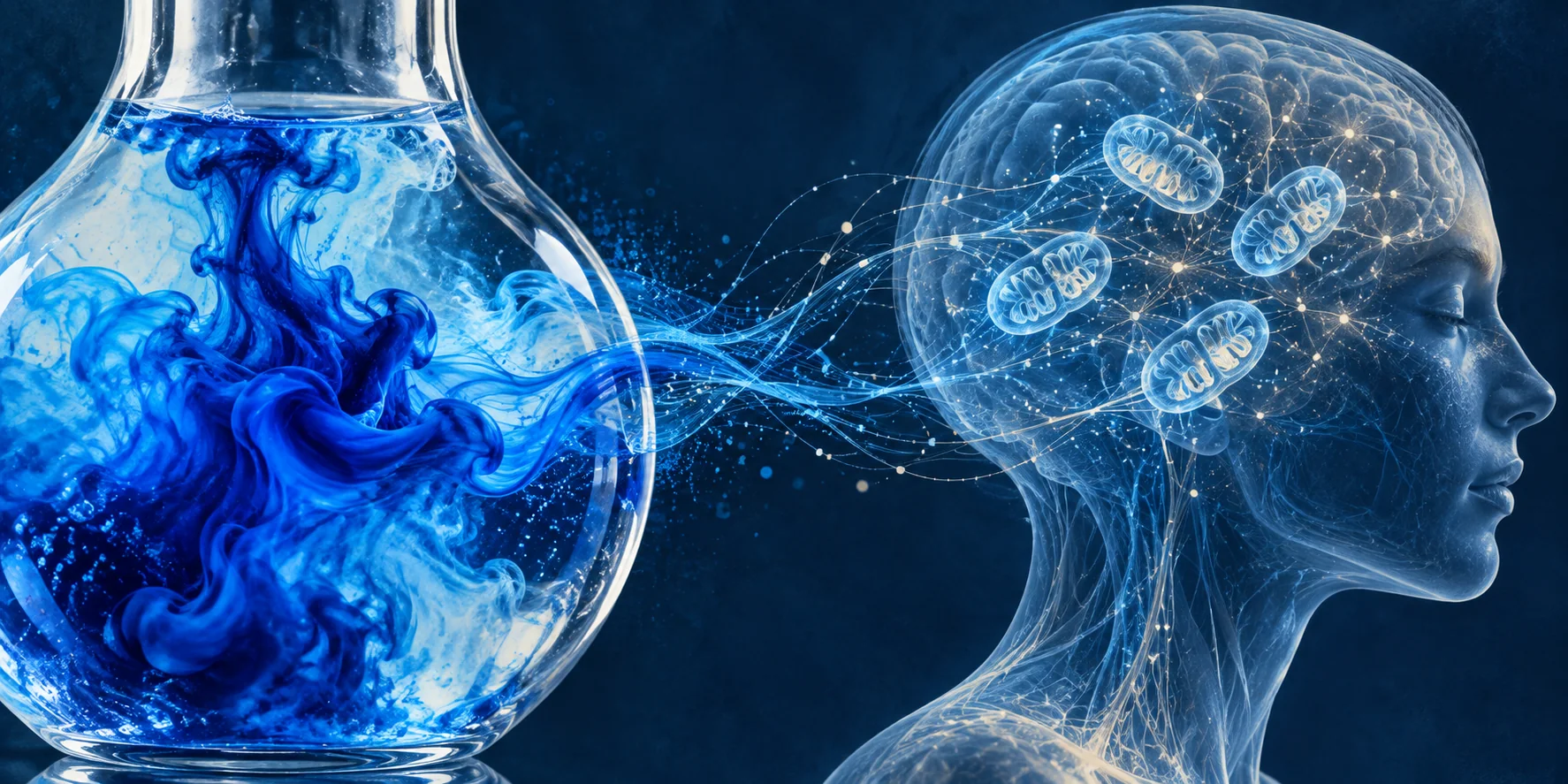
Cells make much of their usable energy in mitochondria. These tiny structures pass electrons through a series of proteins, much as a relay team passes a baton, to help make ATP, the molecule cells spend for work. Methylene blue can accept an electron and then give it away. In laboratory and animal experiments, that ability sometimes lets electrons take an alternative route when parts of the usual mitochondrial chain are blocked. The original alternative-electron-transfer experiment (https://pubmed.ncbi.nlm.nih.gov/21454572/) measured this transfer and protection under experimental stress. It did not show that people with everyday tiredness have a blocked chain or that taking drops improves their lives.
The dose and setting matter. A newer isolated-brain-mitochondria study (https://pubmed.ncbi.nlm.nih.gov/42822383/) found that methylene blue changed oxygen use differently across parts of the energy chain, with some activities rising and others falling as concentration changed. These were mitochondria outside a living person. They make the mechanism more interesting and less simple than the claim that more blue dye always means more cellular energy.
Methylene blue also inhibits an enzyme called monoamine oxidase A, or MAO-A. That enzyme helps break down serotonin and other signaling chemicals. The original human-enzyme experiment (https://pubmed.ncbi.nlm.nih.gov/17721552/) found strong MAO-A inhibition in a laboratory assay. This is a plausible reason for mood effects and a serious reason to consider drug interactions. A cell experiment cannot tell us which amount taken by mouth is safe with a particular antidepressant.
These actions are separate from its established oxygen-carrying role in the blood. Blue urine after use shows that dye or its breakdown products left the body. It does not measure mitochondrial repair, brain benefit, or detoxification.

What human brain studies found
A short memory test after one dose
In the 2016 randomized brain-imaging study (https://pmc.ncbi.nlm.nih.gov/articles/PMC5084971/), 26 healthy adults aged 22 to 62 were assigned to oral methylene blue or a blue-colored placebo. Thirteen were in each group. The researchers tested attention and short-term visual memory in an MRI scanner before treatment and again about an hour later. They also measured brain-activity signals while people did the tasks. The blue placebo helped keep participants and assessors unaware of the assigned group.
People given methylene blue had about 7% more correct responses on the study's memory-retrieval task than the placebo group after the intervention. The MRI signal also changed in brain areas used during attention and memory tasks. A useful way to picture the test is seeing an image, waiting briefly, and deciding whether a later image matches. The result concerns that particular task on that particular day. It does not mean a person remembers 7% more of everything in ordinary life.
The same paper reported no significant improvement in reaction time on its vigilance task. A brighter MRI signal is not the same as fewer mistakes at work, sustained relief from brain fog, or prevention of dementia. This small study excluded people with several medical conditions and those taking psychiatric or serotonin-related medicines. It tested one administration, so it tells us little about months of self-directed use. The research preparation and study conditions also differ from an online product.
A related functional-connectivity trial (https://pmc.ncbi.nlm.nih.gov/articles/PMC5018244/) in healthy adults found changes in how brain regions communicated on MRI after a single oral dose. Connectivity is a map of synchronized brain signals. It is not a direct measure of how well someone manages fatigue, memory, or daily tasks. The finding supports further research into what the substance does in the brain, not a general treatment claim.
The claustrophobia experiment
The 2014 fear-learning trial (https://pubmed.ncbi.nlm.nih.gov/25018057/) enrolled 42 adults with marked fear of enclosed spaces. Everyone spent six short periods in a closed chamber as a form of exposure training. Afterward, 23 received methylene blue and 19 received placebo without knowing which they had. Researchers tested fear in a different chamber a month later and also tested memory for the surrounding context.
Among people whose fear had fallen substantially by the end of training, the methylene blue group tended to retain that improvement better. Among people who remained quite frightened, the methylene blue group tended to do worse at follow-up. The investigators also found better later contextual memory with methylene blue. The important point is that the drug appeared to strengthen memory of the experience, and the experience was not uniformly helpful. This is a small, specific experiment, not evidence that methylene blue treats every anxiety problem.
Mood symptoms are a different outcome
The six-month bipolar-disorder crossover trial (https://pubmed.ncbi.nlm.nih.gov/27284082/) enrolled 37 people who were already taking lamotrigine. Each person received a higher and a lower methylene-blue regimen during different study periods, so researchers could compare symptoms within participants. Depression and anxiety scores improved during the higher-dose period. Cognitive-test results did not show a significant benefit. The lower-dose comparison also contained methylene blue, so it was not a truly inactive placebo.
This study is relevant to claims about mood, but it does not establish methylene blue as a stand-alone antidepressant or as a replacement for bipolar care. It also shows why a good mood report and a memory claim should not be treated as the same result. The site's guide to planning antidepressant changes offers background on why medication changes need care; this trial is not a reason to stop a prescribed drug.
Testimonials from Reddit users
The following are first-person Reddit comments, with each person's own sentence quoted and linked to that exact comment. Usernames, products, medical histories, and outcomes are not independently verified. Reddit posts tend to attract people with striking experiences, and some discussions include product promotion or unsupported dosing advice. The comments help show what users notice; they cannot tell us how often any effect occurs or whether methylene blue caused it.
People who felt clearer or more energetic
u/29SagSmoke wrote: “I have noticed a huge difference in my energy more than anything else.” The writer says the change followed about three months of occasional use and also describes a brighter mood. This is a sustained personal impression, but the comment gives no standardized energy measure or comparison period. Read the original Reddit comment.
u/Pale_Cabinet6136 wrote: “It gives me a significant energy boost which I notice in my workouts.” The user also reports better mood and less desire for alcohol on days of use. Those are separate outcomes, and the post does not establish a treatment for depression or alcohol cravings. Read the original Reddit comment.
u/SnooOnions5818 wrote: “Confidence and ability to focus significantly improved.” This person agreed with another user's report of reduced alcohol cravings. There are no before-and-after tests, so the account is a description of felt change rather than a measured cognitive effect. Read the original Reddit comment.
u/lastpump wrote: “Works very well for me. Twice a week. Much ebtter focus and energy to focus.” The spelling is the writer's. A later reply says the effect seems to last through the week. The comment does not specify a blinded comparison or how long the experience has remained stable. Read the original Reddit comment.
u/CaseyFiles wrote: “Helps energy, mood, focus and confidence. For me.” This person uses it on selected days, such as before a presentation or deadline. Choosing demanding days may make the perceived effect especially noticeable, but it also makes an uncontrolled comparison difficult. Read the original Reddit comment.
u/BrentD22 wrote: “Day 1 and 2 I had extreme benefits with overall well being, more energy, focus calm, breathing better etc.” The user says they continued only every few days and later mentions having one kidney. A single-kidney history makes an online report particularly unsuited to becoming advice for other readers. Read the original Reddit comment.
u/bigjon6ft7 wrote: “Gives you almost instant energy and clear head.” The post says this was early in use and does not include a longer follow-up. An immediate feeling may be real, but it does not tell us whether the substance improves health over time. Read the original Reddit comment.
u/Sad_Mortgage_5510 wrote: “It helps me focus.” The commenter says the difference took about five days to notice. That timing differs from the same-day reports and underlines how variable self-observations can be. Read the original Reddit comment.
u/DramaticProfession51 wrote: “First thing I noticed was MUCH improved sleep quality and efficiency.” The same person then reports better focus and less anxiety. Other commenters describe the opposite effect on sleep, so this is a personal sleep account, not a proven sleep benefit. Read the original Reddit comment.
u/SecretDays wrote: “No more brain fog. Zero anxiety for the last couple days.” The writer also described a strong early feeling of mental clarity. The phrase “last couple days” is important: the post cannot say whether the effect persisted. Read the original Reddit comment.
u/FirstTell5060 wrote: “I still felt there was something between my mind and the outside world. Well, in just a few days that has been fixed.” The 68-year-old writer had already changed diet for months before trying methylene blue and reported several days of clearer thinking. The prior diet and the short observation period complicate any causal conclusion. Read the original Reddit comment.
u/ThenAppointment9743 wrote: “Noticeably elevated mood and energy to get out of the house.” This user says they have bipolar disorder and chose their own amount after reading a study. A few days of improved mood in bipolar disorder needs careful interpretation, especially when changes in sleep or activation may matter. Read the original Reddit comment.
u/Interesting-Fix-9108 wrote: “Within 2 days I actually felt clear and crisp, my brain could function and focus normally.” The writer called their attention problem self-diagnosed. The comment gives a vivid account of workday focus, but neither the diagnosis nor the improvement was measured independently. Read the original Reddit comment.
u/bibbedybobbadybo wrote: “It’s been very very good for energy.” The writer says they are 74 and still work a full week, and also noticed mental clarity. The post does not show whether work ability changed after starting methylene blue. Read the original Reddit comment.
u/Ajsndkakxnfnsjznah wrote: “But once I got to 6mg I started noticing some slight energy more like a light coffee boost so I was slightly disappointed by that but the biggest thing for me was the mental clarity since I have felt brain fog since Covid.” The user had also stopped caffeine. That change could alter how energy feels, and the comment cannot establish a treatment for post-Covid symptoms. Read the original Reddit comment.
People who felt little, nothing, or a fading effect
u/happygolucky226 wrote: “Did nothing for me. Idk if I did it wrong lol.” The user later said they had taken a larger amount than some replies assumed. This short report is easy to overlook in a thread full of dramatic benefits, yet lack of effect is part of the real range of accounts. Read the original Reddit comment.
u/Hairy_Talk_4232 wrote: “The first week I did it, it had a profound effect. I had energy like crazy. Then it slowly diminished in returns so I use a maintenance dose.” The timeline raises questions about adaptation, expectation, or a changing baseline. A comment cannot distinguish among them. Read the original Reddit comment.
u/Traditional_Gap7131 wrote: “I noticed NOTHING after starting MB.” The writer had heard strong praise beforehand and decided the product was not worth continuing. No laboratory test is needed to understand the disappointment, but the comment cannot explain why responses differ. Read the original Reddit comment.
u/jsjames2017 wrote: “I'm up to 30 drops and barely notice anything.” This user said a different tablet contained caffeine and L-theanine, which could explain why that tablet seemed different. The writer also described blue stains on the counter, a mundane reminder that a dye's obvious effects are not proof of a brain effect. Read the original Reddit comment.
u/DrSpitzvogel wrote: “Same for me. No effects at all.” This is another first-person nonresponse, even though the writer tried varying the amount. It is evidence of one person's experience, not a basis for escalating someone else's use. Read the original Reddit comment.
u/PopKiss wrote: “I’ve tried three different brands that were recommended to me on Reddit on a post I made similar to yours, but unfortunately I still experience brain fog too and zero positive effects.” A reply challenged the short time available to test the brands. The exchange shows how uncertain product comparisons and timelines are in online reports. Read the original Reddit comment.
Sleep, stimulation, and uncomfortable reactions
u/Brickster1985 wrote: “It's not a buzzy wired, just like a more aware type of feeling.” This second-day user also mentioned occasional calf pain and uncertainty about any cellular benefit. The timing is not enough to tell whether the pain was caused by methylene blue. Read the original Reddit comment.
u/False-Pen6678 wrote: “Like as soon as I close my eyes I start seeing things.” The commenter described tiring visual experiences after months of use. This is a subjective report with no clinical assessment, but unusual perceptions are a reason to seek professional advice rather than treat the effect as a sign of enhanced brain power. Read the original Reddit comment.
u/Specialist-Turn-797 wrote: “5 hampered my sleep as well.” The commenter says sleep improved after changing their own use. The reply does not establish a safe amount for anyone else; its value here is that sleep disruption was noticeable enough to report. Read the original Reddit comment.
u/No-Rock-7966 wrote: “Today I am experimenting with only 2 mg.” The same writer listed worse sleep quality, strange vision, and flatter feelings alongside better memory and focus. Those mixed effects are more informative than a simple good-or-bad rating and warrant caution, especially because the commenter also mentioned another psychoactive substance. Read the original Reddit comment.
u/design_bird wrote: “I’m taking 12 drops and feel pretty good but finding I have peaks and valleys in my moods.” The post asks for dosing help, which an anonymous thread cannot safely provide. The mood variation itself is a reason to consider personal health context and other medicines. Read the original Reddit comment.
u/ksvfgfg4 wrote: “I’ve taken MB (10 drops) for two days and went into extreme fatigue.” The writer wondered whether this was a “herx” reaction. That label is the person's speculation, not a diagnosis or evidence of a helpful detoxification process. A new severe symptom deserves assessment on its own terms. Read the original Reddit comment.
u/Vloshko wrote: “However, this effect from Methylene Blue persisted much longer than I anticipated.” The user described unusually prolonged stimulation and compared the experience with another psychoactive drug. The comparison is subjective, but the longer-than-expected effect is relevant to anyone assuming that a brief self-test will be easy to reverse. Read the original Reddit comment.
u/Ok-Construction6222 wrote: “My depression has been reduced to a level that sertraline just couldn't achieve.” This is an unverified personal comparison, not evidence that methylene blue is better than sertraline. The comment does not clearly establish whether the two drugs overlapped. Because serotonin-related interactions can be dangerous, nobody should copy a regimen from this account or stop a prescription to try it. Read the original Reddit comment.
u/Lightness_Being wrote: “I have noticed a lot more clarity in my thinking.” This user was also coming off duloxetine, called Cymbalta, and described changes in daytime alertness and insomnia. A medication change can strongly affect both mood and cognition. Methylene blue can interact with serotonin-related drugs, so this account should prompt questions for a prescriber, not an imitation. Read the original Reddit comment.
The safety questions online reviews cannot settle
The current US methylene-blue injection label carries a boxed warning about serious or fatal serotonin syndrome when used with serotonin-related medicines or opioids. The label names antidepressants including SSRIs and SNRIs, as well as certain other drugs and dextromethorphan. Oral self-use has not been studied well enough to declare a safe combination from a small online dose. Do not stop an antidepressant abruptly in order to experiment with methylene blue. A pharmacist or clinician needs the complete medication and supplement list.
The same label contraindicates methylene blue in people with G6PD deficiency because red blood cells may break down, causing anemia. This inherited enzyme deficiency can be present without obvious day-to-day symptoms. The label also warns about pregnancy, breastfeeding, and possible effects in people with kidney or liver problems. Blue or green urine can be expected, while confusion, fever, shaking, severe agitation, trouble breathing, or a fast heart rate after use calls for prompt medical care. These warnings come from clinical methylene-blue products; the uncertainties of an online preparation add to them rather than erase them.
Quality is another issue. The MRI study used a specified U.S. Pharmacopeia-grade preparation under research oversight. A chemical sold for staining, laboratory work, or aquariums is not established as a human medicine just because the molecule has the same name. The US Pharmacopeia methylene-blue standard addresses identity and impurities. A product label's claim of purity is not the same as independent verification of the finished product. This article does not give a self-dosing plan because the human evidence does not establish one for brain fog or energy.
What the evidence means for a reader
Methylene blue can affect blood oxygen chemistry, mitochondrial electron flow, brain-imaging signals, and MAO-A activity. Those are different effects demonstrated in different settings. The strongest everyday cognition finding here is a one-day memory-task result in 26 carefully selected adults. The longer bipolar study found improvements in some mood ratings, but no significant cognitive benefit. Neither study establishes a treatment for chronic fatigue, ADHD, long Covid, Alzheimer disease, or general brain fog.
The linked Reddit accounts make the unanswered questions concrete. Some people felt unusually clear or energetic, some noticed nothing, and others described sleep loss, fatigue, or distressing sensations. Their words are useful for recognizing possible experiences and questions to ask. They do not replace the controlled studies, product-quality checks, or an assessment of what is causing a person's symptoms.